A single trapped ion beats break-even without measuring errors
A 23 October 2026 Nature Physics paper from the University of Science and Technology of China reports a logical qubit encoded in one ion whose lifetime passed that of the best physical qubit in the same system.
Listen
AI-generated voices, script based on this article · 4:21
In a Nature Physics paper published 23 October 2026, Yi Li, Qingyuan Mei, Qing-Xuan Jie and colleagues at the University of Science and Technology of China, with Jiangfeng Du of Zhejiang University, report autonomous quantum error correction with a logical qubit encoded in multiple internal spin states of a single trapped ion, crossing the break-even point for qubit lifetime. Li, Mei and Jie are co-first authors. Yiheng Lin directed the experiment; Lin and Du supervised the project. Chang-Ling Zou, Lin and Du are the corresponding authors.
The authors use engineered spin–motion couplings to dump error entropy into shared motional modes, which are then cooled by an ancilla ion, so no syndrome measurement or classical feedback is required. The paper's abstract says that repeatedly applying the protocol extended lifetime past break-even under both ambient laboratory conditions and injected low-frequency magnetic noise.
An official university account of the published paper, posted 26 October 2026, gives the measured lifetimes. Under laboratory noise, it says, the corrected logical qubit lasted about 42 milliseconds, compared with 29.4 milliseconds for the best physical qubit and 24.7 milliseconds for the uncorrected logical qubit. With injected low-frequency magnetic noise, the same account reports 11.7 milliseconds for the protected qubit, versus 0.98 milliseconds for the best physical qubit and 0.83 milliseconds for the uncorrected logical qubit. The university describes the encoding as four Zeeman levels in the 32D5/2 manifold of a single 40Ca+ ion, with a second ion used for cooling.
The result is a hardware-efficient memory demonstration in a single ion, not a multi-logical-qubit processor. Break-even here is a lifetime comparison, not a full fault-tolerant computation. The university notes that the present protocol mainly addresses phase errors on one logical qubit.
Why it matters
Conventional error correction often needs several physical qubits plus fast measurements and feedback. A protocol that, in this experiment, encodes a logical qubit in one ion and still beats the best physical lifetime in the same trap shows a lower-overhead route to a more stable ion-trap memory — if it can later be extended to gates between logical qubits.
Looking ahead (speculative)
The next test is whether the same autonomous cycle can protect operations between several logical ions, not just the memory of one. That has not been shown here, and a gain under injected magnetic noise is not the same as a fault-tolerant processor.
Sources
Sources
More in Quantum
Quantum
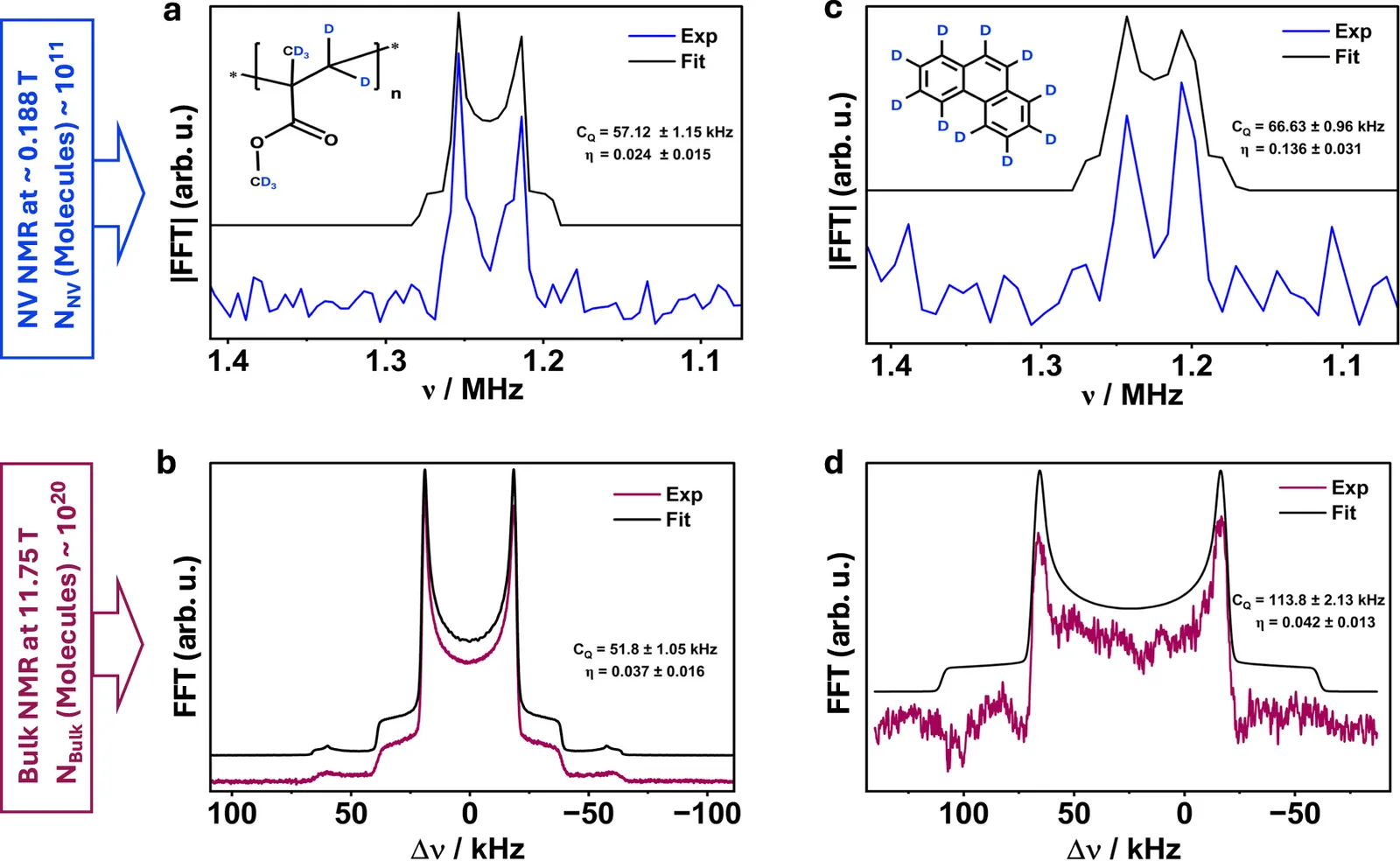
Diamond NV sensors record deuterium NMR from nanometer-scale volumes in the lab
A Nature Communications paper published 19 November 2026 reports nitrogen-vacancy centers in diamond collecting deuterium NMR spectra from nanometer-scale volumes at magnetic fields far below those used in conventional instruments.
Quantum
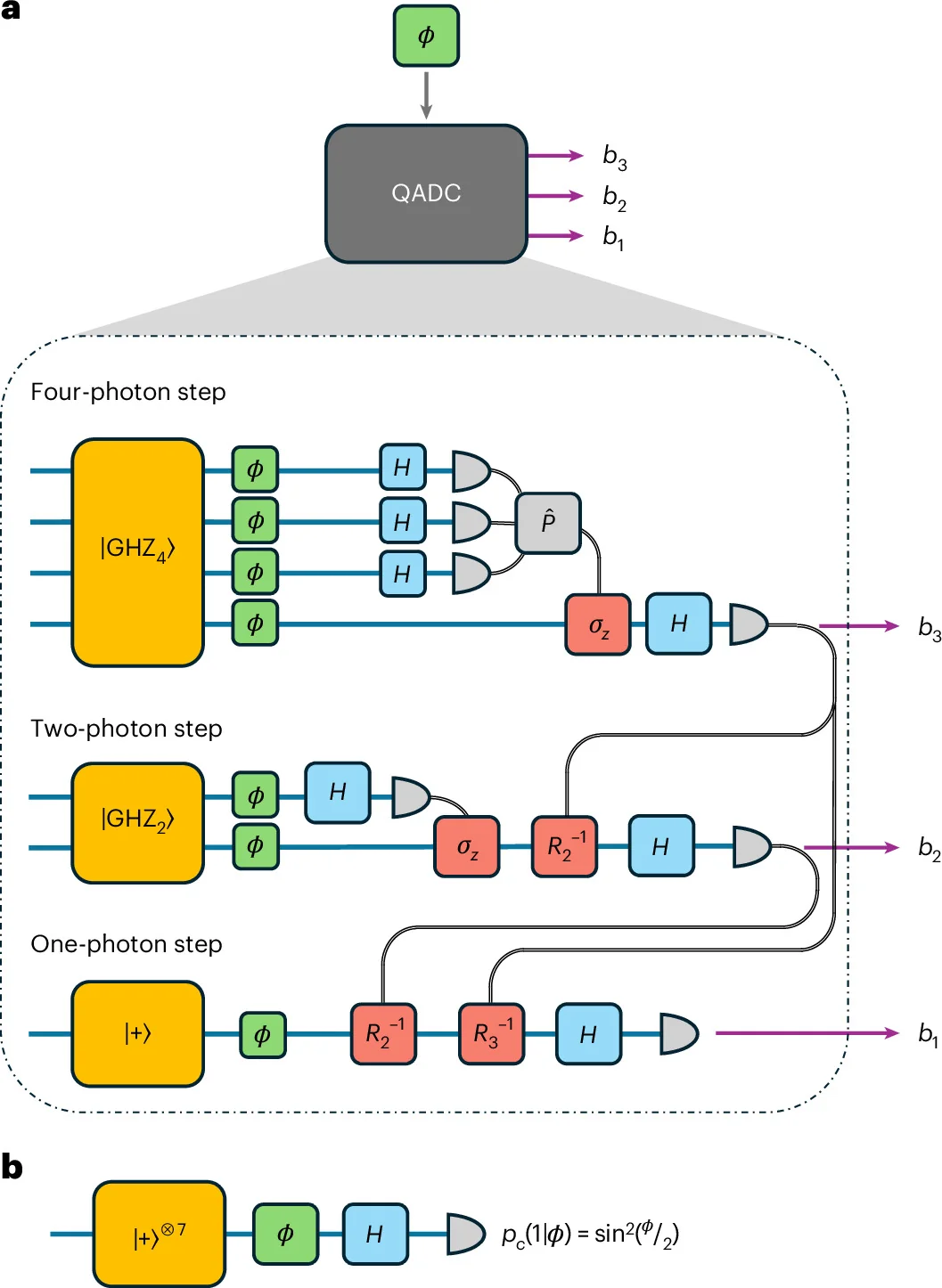
A photonic chip encodes an unknown optical phase as a three-bit estimate
A Nature Photonics paper published 20 November 2026 reports a laboratory quantum analogue-to-digital converter that turns a continuous optical phase into a three-bit string.
Quantum
Autonomous error correction keeps a cavity logical qubit alive past break-even
A 16 November 2026 Nature Physics paper reports a photonic logical qubit in a superconducting microwave cavity whose lifetime was about 2.0 milliseconds, 18% longer than the best physical qubit in the same system.
Quantum
A designed molecule links a spin qubit to a photon
A Nature paper published 28 October 2026 reports a laboratory demonstration, at 4.5 K, of a single carbene molecule that can be optically addressed as a spin–photon interface.