A photonic chip encodes an unknown optical phase as a three-bit estimate
A Nature Photonics paper published 20 November 2026 reports a laboratory quantum analogue-to-digital converter that turns a continuous optical phase into a three-bit string.
Listen
AI-generated voices, script based on this article · 4:14
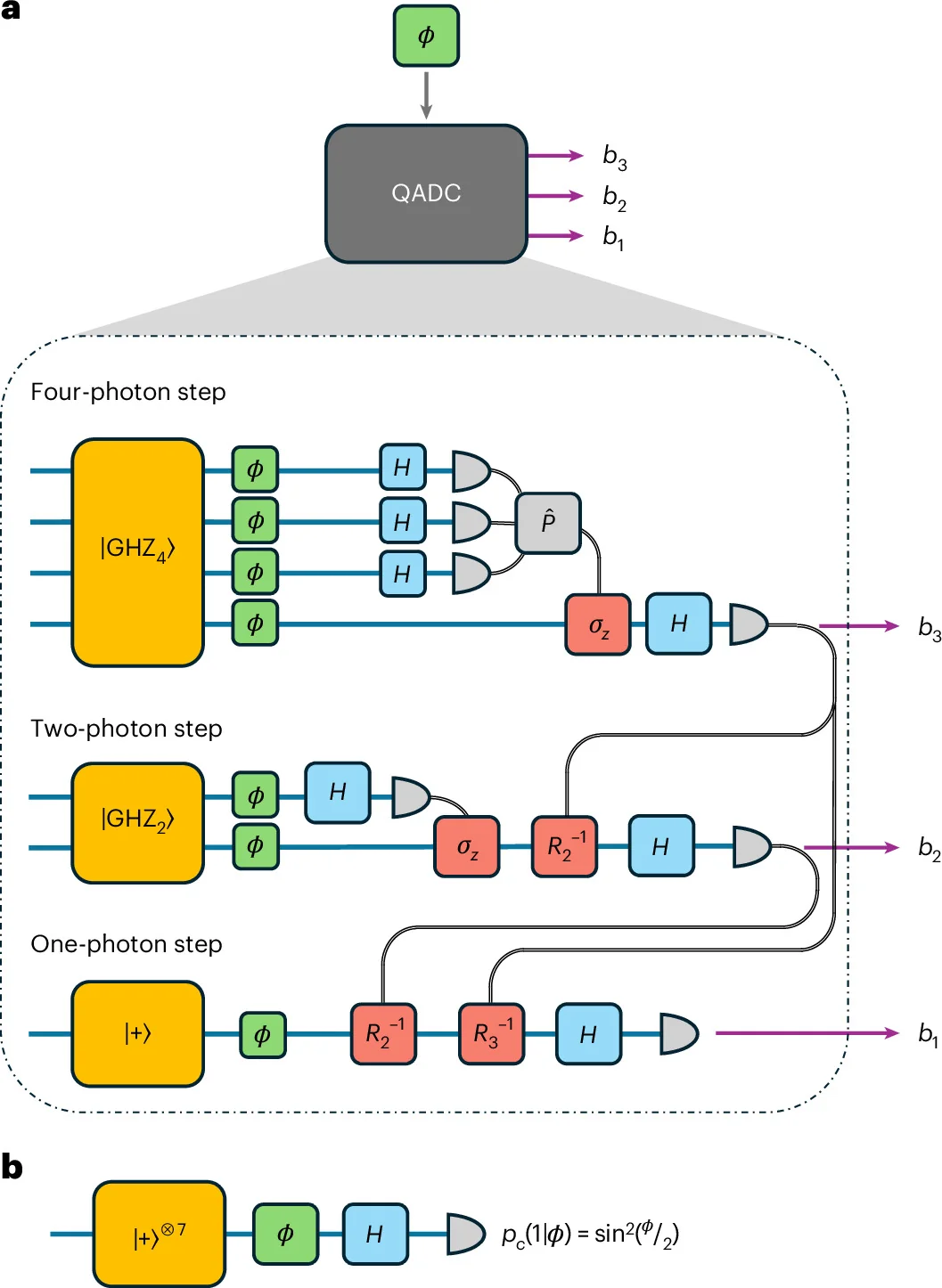
Nature Photonics published an open-access paper on 20 November 2026 in which Eugenio Caruccio, Simone Roncallo, Valeria Cimini, and colleagues report a photonic experiment that they describe as the first laboratory realization of a quantum analogue-to-digital converter for metrology. Corresponding authors are Chiara Macchiavello of the University of Pavia and Fabio Sciarrino of Sapienza University of Rome. Co-authors are at Sapienza, Pavia, the Institute for Photonics and Nanotechnologies of Italy's National Research Council (IFN-CNR) in Milan, and Ephos in Milan. Giacomo Corrielli and Roberto Osellame are co-founders of Ephos; Ciro Pentangelo is affiliated with the company.
The device takes a continuous unknown optical phase as input and outputs a three-bit string. The team programmed an eight-mode, fully reconfigurable integrated interferometer and used a quantum-dot source of highly indistinguishable photons. The protocol runs in three stages, with four-photon, two-photon, and single-photon probes, including entangled GHZ-type states in the first two steps. The classical comparison is an entanglement-free interferometric estimate.
To test the scheme, the authors collected measurements for 99 phase values evenly spaced over a full 2π range, with up to 5,377 shots per phase. They used a denoising autoencoder and other machine-learning tools to mitigate experimental noise. At moderate shot counts, they report that the quantum strategy recovered more mutual information between the bit string and the unknown phase than the classical approach. That edge faded as the number of phase repetitions grew, which the authors attribute to noise that weighs more heavily on the quantum probes.
This is a laboratory demonstration of a three-bit protocol, not a fielded sensor. The reported advantage is not robust across all noise and repetition regimes.
Why it matters
Much of quantum metrology is scored on continuous error measures. Digital instruments, by contrast, care about how many reliable bits come out. A working photonic converter gives researchers a way to test whether quantum probes can add useful bits, not only smaller analogue error bars.
Looking ahead (speculative)
If later devices can keep the moderate-shot advantage as they add bits or face noisier conditions, the same digital scoring could be tried in other sensors. That step has not been taken here.
Sources
Sources
More in Quantum
Quantum
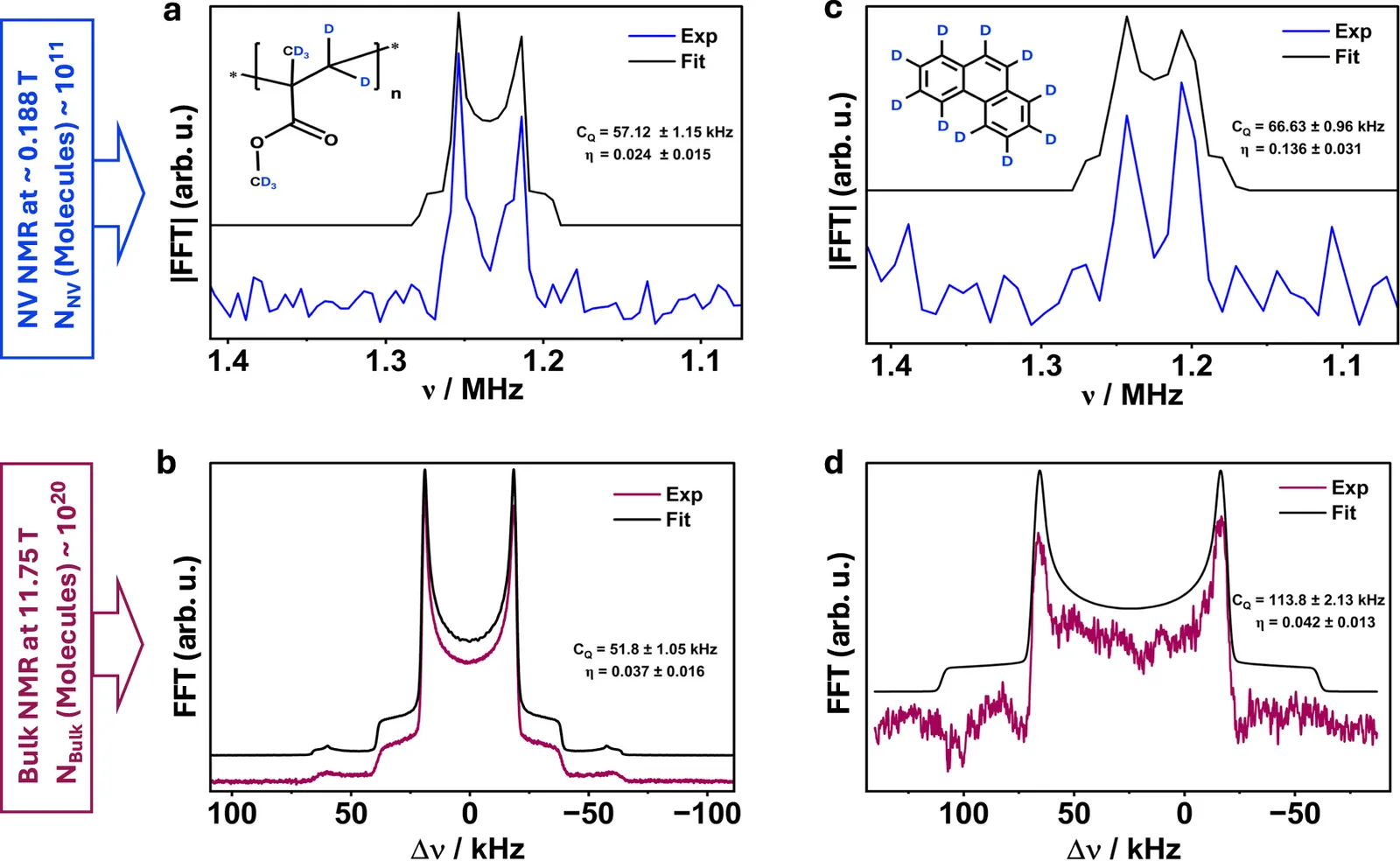
Diamond NV sensors record deuterium NMR from nanometer-scale volumes in the lab
A Nature Communications paper published 19 November 2026 reports nitrogen-vacancy centers in diamond collecting deuterium NMR spectra from nanometer-scale volumes at magnetic fields far below those used in conventional instruments.
Quantum
Autonomous error correction keeps a cavity logical qubit alive past break-even
A 16 November 2026 Nature Physics paper reports a photonic logical qubit in a superconducting microwave cavity whose lifetime was about 2.0 milliseconds, 18% longer than the best physical qubit in the same system.
Quantum
A designed molecule links a spin qubit to a photon
A Nature paper published 28 October 2026 reports a laboratory demonstration, at 4.5 K, of a single carbene molecule that can be optically addressed as a spin–photon interface.
Quantum
Color codes run below threshold on Quantinuum's Helios trapped-ion processor, a preprint reports
A 16 October 2026 preprint describes triangular color codes of distances 3, 5 and 7, with logical error rates as low as 5 × 10⁻⁶ per cycle and a reported memory suppression factor of about 12 for each step up in distance.