Diamond NV sensors record deuterium NMR from nanometer-scale volumes in the lab
A Nature Communications paper published 19 November 2026 reports nitrogen-vacancy centers in diamond collecting deuterium NMR spectra from nanometer-scale volumes at magnetic fields far below those used in conventional instruments.
Listen
AI-generated voices, script based on this article · 4:32
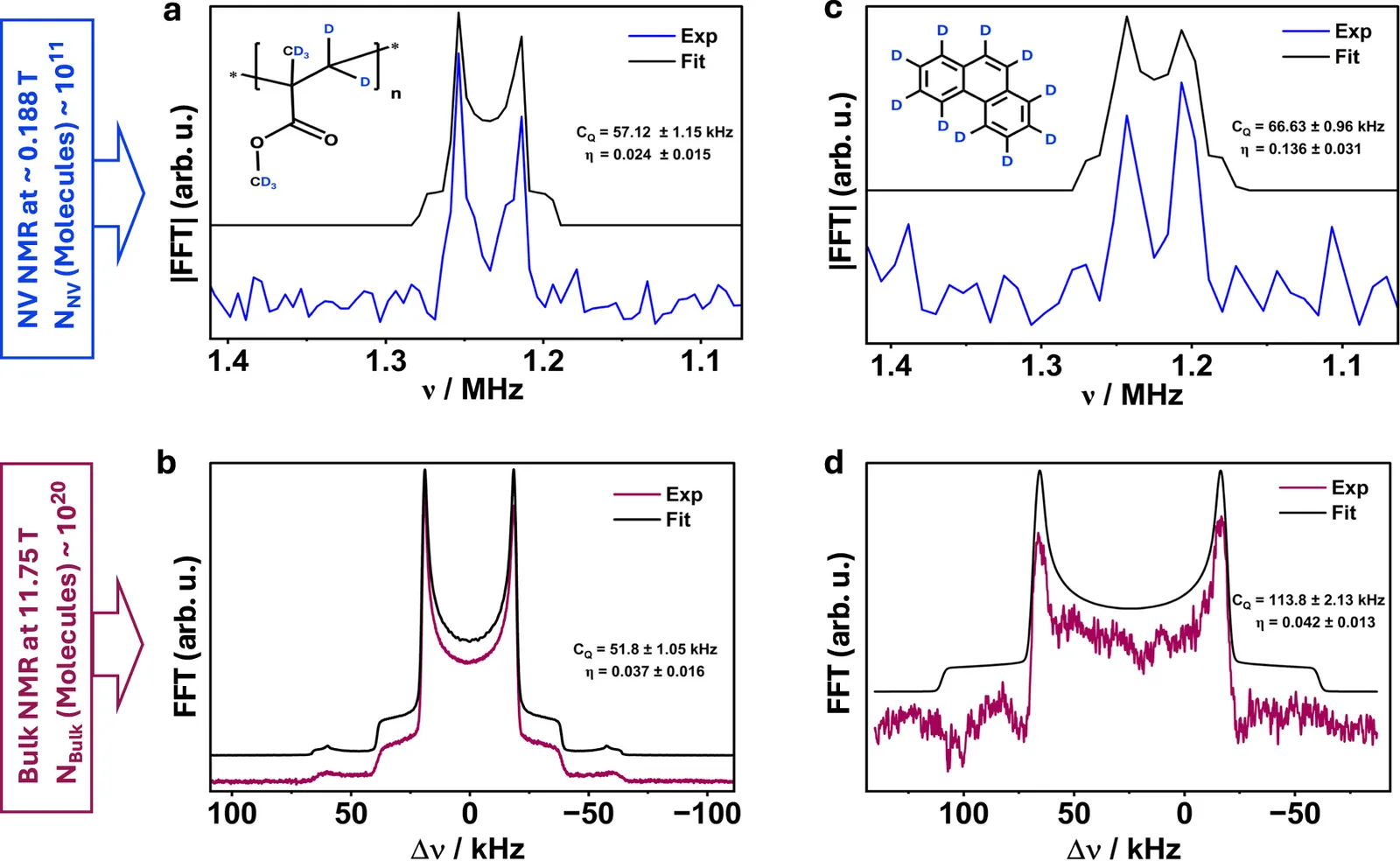
Nature Communications published an open-access paper on 19 November 2026 in which Dileep Singh, Riley W. Hooper, Christoph Findler, Utsab Banerjee, and corresponding author Dominik B. Bucher report deuterium nuclear magnetic resonance (NMR) spectra recorded with nitrogen-vacancy (NV) centers in diamond. Singh, Hooper, Banerjee, and Bucher are at the Technical University of Munich and the Munich Center for Quantum Science and Technology; Findler is at Diatope GmbH.
The measurements were made on selected laboratory samples: a thin film of deuterated poly(methyl methacrylate), PMMA-d8, and the molecular solid phenanthrene-d10. Near-surface NV centers, implanted a few nanometers below a diamond surface, sensed statistical fluctuations from deuterium spins in a nanometer-scale volume. The authors compare those spectra with conventional bulk NMR acquired at 11.75 tesla. NV-NMR experiments ran at 174 to 189 millitesla, about two orders of magnitude lower, and the benchmarking comparison uses 188 millitesla.
The authors report a sensitivity gain of seven to eight orders of magnitude in spin sensitivity over inductive detection. For PMMA-d8, they write that the NV measurement reached about 3×10^13 spins per square-root hertz, compared with about 3×10^20 for bulk inductive NMR, an improvement of more than seven orders of magnitude, and that the quadrupolar powder line shape resembles the bulk spectrum. For phenanthrene-d10, they report an improvement of approximately eight orders of magnitude and a reduced effective quadrupolar coupling relative to the bulk measurement. Variable-temperature NV-NMR of the polymer showed little change up to about 150 degrees Celsius, while phenanthrene-d10 showed motional averaging and a collapse of quadrupolar features as the sample approached its melting point.
This is laboratory spectroscopy on two deuterated materials, not a clinical or industrial NMR instrument. The authors write that they do not see NV-based NMR as an alternative to conventional NMR, but as a tool to probe interfaces and surfaces. Bucher is a cofounder and advisor of QuantumDiamonds GmbH, which the paper says had no relationship with this study, and Findler is a co-founder and shareholder of Diatope GmbH, which provided the diamond material, and the paper says Findler declares a potential financial interest in that material but was not involved in the deuterium measurements or their analysis.
Why it matters
Deuterium NMR is a standard way to watch molecular motion, but conventional instruments need large samples and high magnetic fields. Recovering familiar quadrupolar line shapes from nanometer-scale volumes at much lower field gives interface studies a spectroscopic handle they usually lack.
Looking ahead (speculative)
The authors suggest uses at interfaces, in confined samples, and in materials science. Those applications are not demonstrated here, and they note that the present signal-to-noise ratio remains lower than in conventional bulk inductive NMR.
Sources
Sources
More in Quantum
Quantum
A photonic chip encodes an unknown optical phase as a three-bit estimate
A Nature Photonics paper published 20 November 2026 reports a laboratory quantum analogue-to-digital converter that turns a continuous optical phase into a three-bit string.
Quantum
Autonomous error correction keeps a cavity logical qubit alive past break-even
A 16 November 2026 Nature Physics paper reports a photonic logical qubit in a superconducting microwave cavity whose lifetime was about 2.0 milliseconds, 18% longer than the best physical qubit in the same system.
Quantum
A designed molecule links a spin qubit to a photon
A Nature paper published 28 October 2026 reports a laboratory demonstration, at 4.5 K, of a single carbene molecule that can be optically addressed as a spin–photon interface.
Quantum
Color codes run below threshold on Quantinuum's Helios trapped-ion processor, a preprint reports
A 16 October 2026 preprint describes triangular color codes of distances 3, 5 and 7, with logical error rates as low as 5 × 10⁻⁶ per cycle and a reported memory suppression factor of about 12 for each step up in distance.