A designed molecule links a spin qubit to a photon
A Nature paper published 28 October 2026 reports a laboratory demonstration, at 4.5 K, of a single carbene molecule that can be optically addressed as a spin–photon interface.
Listen
AI-generated voices, script based on this article · 4:19
A paper published in Nature on 28 October 2026 reports a triplet ground-state carbene molecule, embedded in a structurally matched host crystal, that can be addressed as a single-molecule spin–photon interface. The article is open access under a Creative Commons Attribution 4.0 license. Corresponding authors are Matthias Pfender and Ilai Schwartz of NVision Quantum Technologies in Ulm, Germany, writing with colleagues at NVision, Ulm University and the Hebrew University of Jerusalem.
The qubit molecule is di([1,1′-biphenyl]-4-yl)carbene, hosted in a crystalline di([1,1′-biphenyl]-4-yl)methanone matrix. According to the paper, the emitter shows narrow zero-phonon lines, spectral stability over more than an hour, spin-selective optical transitions and single-molecule optically detected magnetic resonance. Coherent control at 4.5 K, the authors report, gave a dynamical-decoupling coherence time of T2(XY8) = 2.2(3) ms and a spin-lattice relaxation time of T1 = 21(2) ms.
The work is a laboratory demonstration of a single emitter at 4.5 K, not a multi-node quantum network. In discussing requirements for a network node, the authors include photon indistinguishability between remote nodes and high-fidelity spin–photon entanglement; those networking protocols are not reported in this experiment.
In a same-day company blog post, NVision describes the result as the first individually addressable organic molecular qubit with a photonic interface and as a building block of its PIQC architecture. Those comparisons and product plans are the company's own.
Most of the authors are employees of NVision Quantum Technologies, and several, including corresponding author Ilai Schwartz, are shareholders of the company, which is commercializing products in quantum information technology.
Why it matters
Most optically addressed spin qubits today are defects in solids such as diamond, whose properties are largely set by the host crystal. A single, chemically designed molecule that can be prepared, controlled and read out with light, if the result holds up, would let chemists tune the interface rather than only engineer around a found defect.
Looking ahead (speculative)
Whether photons from separate molecules can be made indistinguishable, and whether remote entanglement can be generated, are the obvious next tests for a networked architecture. This paper does not show those steps.
Sources
Sources
More in Quantum
Quantum
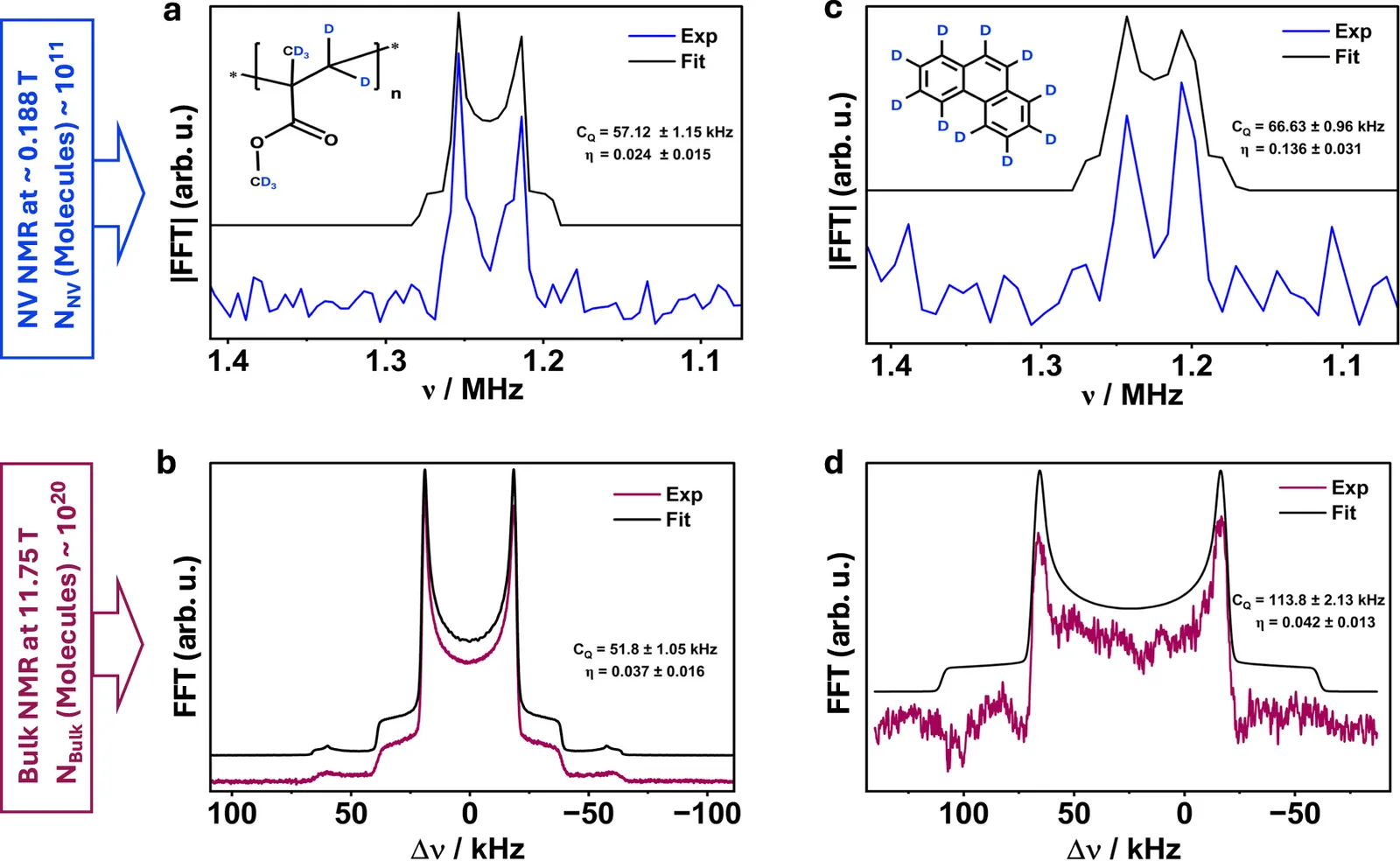
Diamond NV sensors record deuterium NMR from nanometer-scale volumes in the lab
A Nature Communications paper published 19 November 2026 reports nitrogen-vacancy centers in diamond collecting deuterium NMR spectra from nanometer-scale volumes at magnetic fields far below those used in conventional instruments.
Quantum
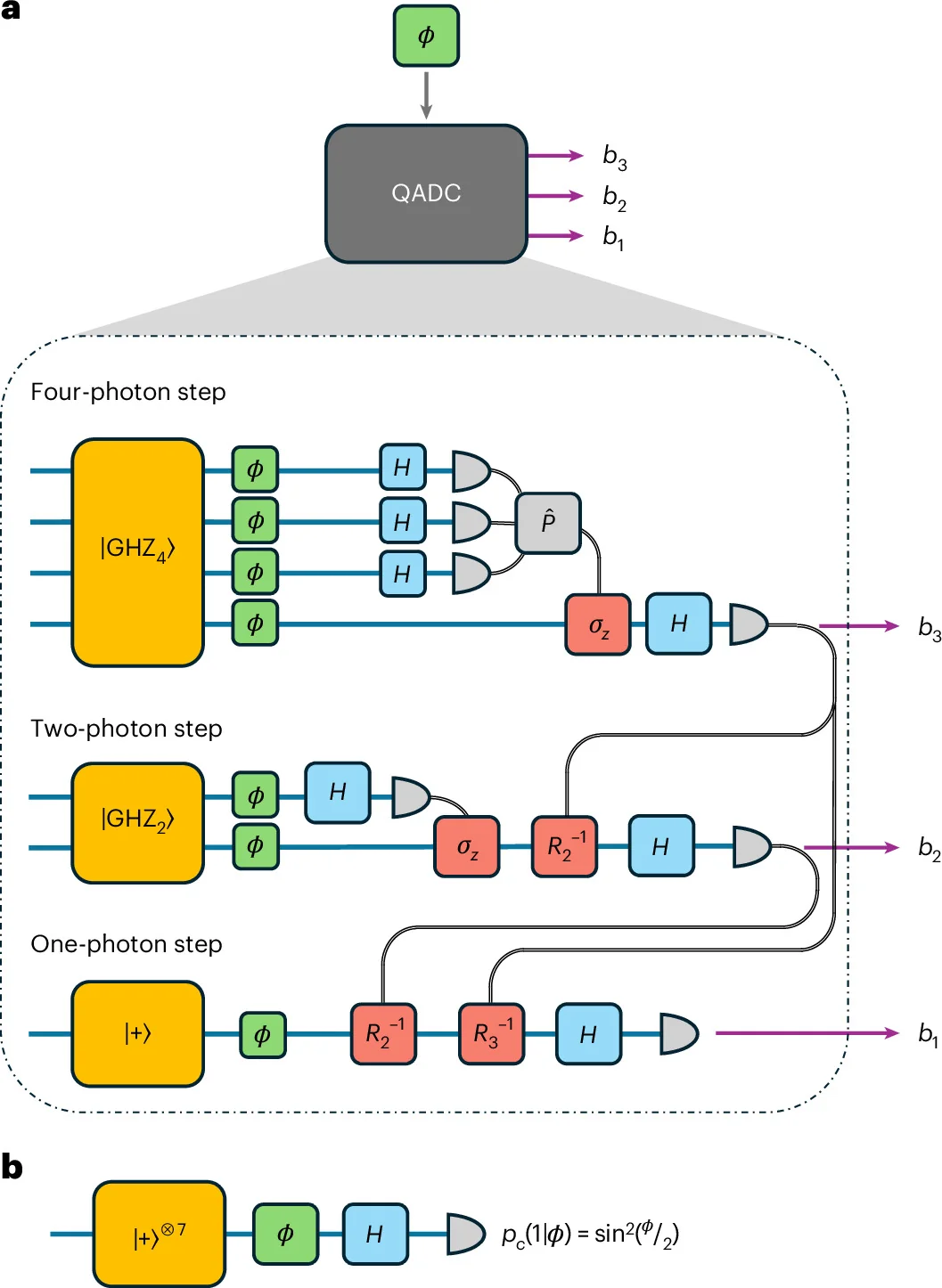
A photonic chip encodes an unknown optical phase as a three-bit estimate
A Nature Photonics paper published 20 November 2026 reports a laboratory quantum analogue-to-digital converter that turns a continuous optical phase into a three-bit string.
Quantum
Autonomous error correction keeps a cavity logical qubit alive past break-even
A 16 November 2026 Nature Physics paper reports a photonic logical qubit in a superconducting microwave cavity whose lifetime was about 2.0 milliseconds, 18% longer than the best physical qubit in the same system.
Quantum
Color codes run below threshold on Quantinuum's Helios trapped-ion processor, a preprint reports
A 16 October 2026 preprint describes triangular color codes of distances 3, 5 and 7, with logical error rates as low as 5 × 10⁻⁶ per cycle and a reported memory suppression factor of about 12 for each step up in distance.