Autonomous error correction keeps a cavity logical qubit alive past break-even
A 16 November 2026 Nature Physics paper reports a photonic logical qubit in a superconducting microwave cavity whose lifetime was about 2.0 milliseconds, 18% longer than the best physical qubit in the same system.
Listen
AI-generated voices, script based on this article · 4:10
In a Nature Physics paper published 16 November 2026, Zhongchu Ni, Ling Hu, Yanyan Cai and colleagues report an autonomous quantum error-correction protocol that extends a logical qubit's lifetime past break-even — the point at which the protected logical qubit outlasts the best physical qubit in the same device. The work is from the International Quantum Academy in Shenzhen, with collaborators at the Shenzhen Branch of Hefei National Laboratory, the Southern University of Science and Technology, and Fuzhou University. Corresponding authors are Yuan Xu of the International Quantum Academy and Shi-Biao Zheng of Fuzhou University.
The team encoded a photonic logical qubit in a superconducting microwave cavity, in a circuit quantum-electrodynamics setup, and protected it against photon loss with engineered dissipation rather than by measuring an error syndrome and applying classical feedback. The authors report that the protected qubit's lifetime was about 2.0 milliseconds, 18% longer than that of the best physical qubit available in the system. They also used the protocol to measure a small frequency shift, obtaining a metrological gain of 6.3 decibels relative to the most robust Fock-state superposition.
The experiment is a single-cavity demonstration on one dominant error channel, photon loss. It is not a complete, scalable fault-tolerant architecture, and it does not show a multi-logical-qubit computation.
Why it matters
Most error-correction demonstrations still rely on repeated syndrome measurements and fast classical feedback, which add control overhead. A protocol that crosses break-even with engineered dissipation, if it can be extended to more error types, would be a leaner way to keep a bosonic memory alive — and, in this study, a more precise way to sense a small frequency shift.
Looking ahead (speculative)
If the same autonomous loop can be cascaded to handle additional errors, or wired into a larger processor, it could become a practical ingredient in bosonic architectures. Those steps have not been shown here, and a gain of 18% on one cavity is a memory result, not a fault-tolerant computer.
Sources
Sources
More in Quantum
Quantum
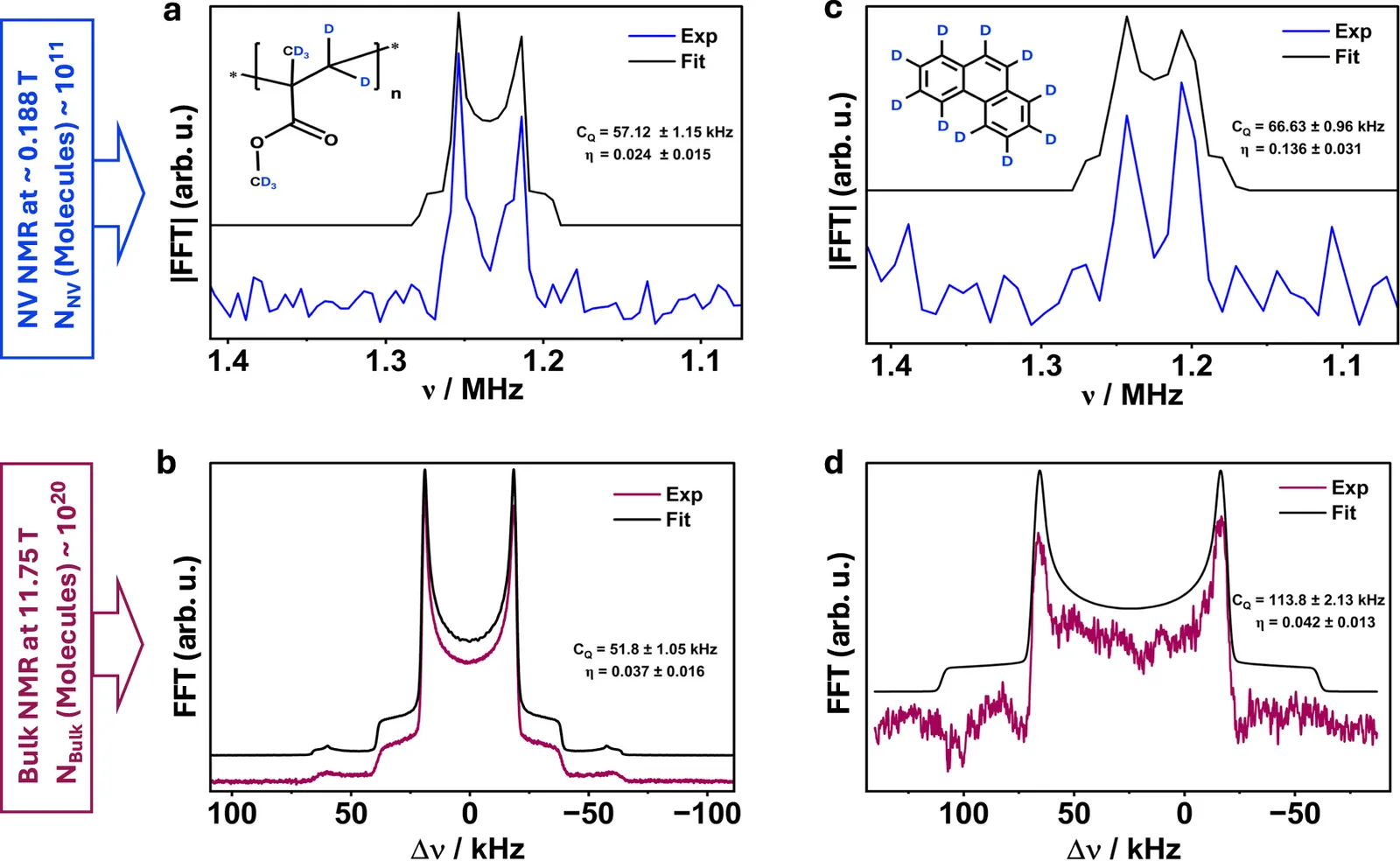
Diamond NV sensors record deuterium NMR from nanometer-scale volumes in the lab
A Nature Communications paper published 19 November 2026 reports nitrogen-vacancy centers in diamond collecting deuterium NMR spectra from nanometer-scale volumes at magnetic fields far below those used in conventional instruments.
Quantum
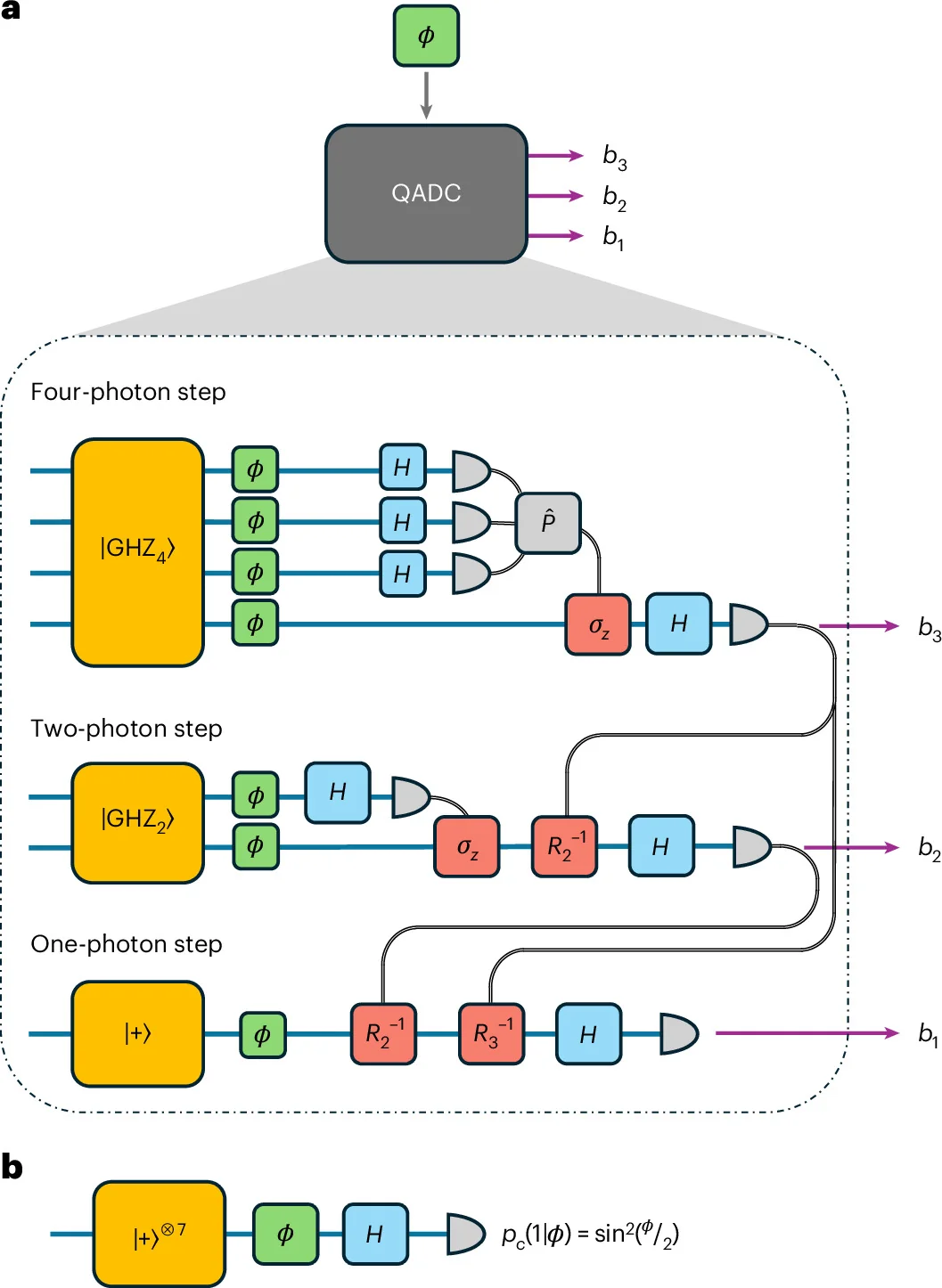
A photonic chip encodes an unknown optical phase as a three-bit estimate
A Nature Photonics paper published 20 November 2026 reports a laboratory quantum analogue-to-digital converter that turns a continuous optical phase into a three-bit string.
Quantum
A designed molecule links a spin qubit to a photon
A Nature paper published 28 October 2026 reports a laboratory demonstration, at 4.5 K, of a single carbene molecule that can be optically addressed as a spin–photon interface.
Quantum
Color codes run below threshold on Quantinuum's Helios trapped-ion processor, a preprint reports
A 16 October 2026 preprint describes triangular color codes of distances 3, 5 and 7, with logical error rates as low as 5 × 10⁻⁶ per cycle and a reported memory suppression factor of about 12 for each step up in distance.