Tailored interfaces push solid-state lithium-sulfur lab cells toward a projected 500 Wh/kg
A Nature Materials paper published 20 November 2026 reports sulfide-based all-solid-state lithium-sulfur cathodes with high areal capacity; the authors project pouch-cell energy densities above 500 watt-hours per kilogram.
Listen
AI-generated voices, script based on this article · 3:53
Nature Materials published a paper on 20 November 2026 in which Yukio Cho, Hongchang Hao, and colleagues report sulfide-based all-solid-state lithium-sulfur cathodes whose sulfur-sulfide and sulfur-carbon interfaces were engineered to improve ion and electron transport. Corresponding authors are Cho and Jagjit Nanda, at the SLAC-Stanford Battery Center and partner groups at Stanford University and other institutions. Cho and Nanda declare that a provisional patent (U.S. provisional patent application number 64/054,242, 2026) has been filed on the work; the other authors declare no competing interests.
The authors argue that interfacial ion and electron transport is a critical lever for energy density in these batteries, rather than tortuous pathways in high-loading cathodes alone. They describe enabling partial lithiation at the sulfur-sulfide interface and removing an electron-impeding oxidation layer at the sulfur-carbon interface.
In laboratory cells, they report areal capacities near 15 milliamp-hours per square centimeter and sulfur utilization above 90% at a stack pressure of 15 to 25 megapascals. Those metrics, the authors write, correspond to projected pouch-cell-level energy densities surpassing 500 watt-hours per kilogram. That 500 watt-hours-per-kilogram figure is a projected pouch-cell value, not a demonstrated commercial pack. Fast cycling at a 1C rate retained 82.1% of capacity over 500 cycles, with Coulombic efficiencies of up to 99.9%. The team also reports stable cycling with a lithium-metal anode at 10 megapascals, instead of the more common lithium-indium alloy. The authors describe 15 to 25 megapascals as a moderate stack pressure.
This is a laboratory-cell study, not a commercial solid-state pack. The abstract presents 500 watt-hours per kilogram as a projection from those metrics, not as a measured pouch cell.
Why it matters
Lithium-sulfur chemistry is often discussed for its theoretical energy density, but high-loading solid-state cells usually struggle to move ions and electrons through the cathode. A laboratory result that reaches high areal capacity at documented stack pressure, and then projects a pouch-cell figure above 500 watt-hours per kilogram, gives a clear benchmark for later cells to meet or miss.
Looking ahead (speculative)
The authors present interfacial control inside composite cathodes as a design route for high-energy-density all-solid-state lithium-sulfur batteries. Whether those projected pouch-cell values can be realized in practical packs is not shown here.
Sources
Sources
More in Energy
Energy
Entropy-tuned lead-free ceramic capacitors reach 21.5 J/cm³ in laboratory devices
A Nature Communications paper published 21 November 2026 reports laboratory multilayer ceramic capacitors, made from a lead-free high-entropy relaxor ferroelectric, with a recoverable energy-storage density of 21.5 joules per cubic centimeter at 1,200 kilovolts per centimeter.
Energy
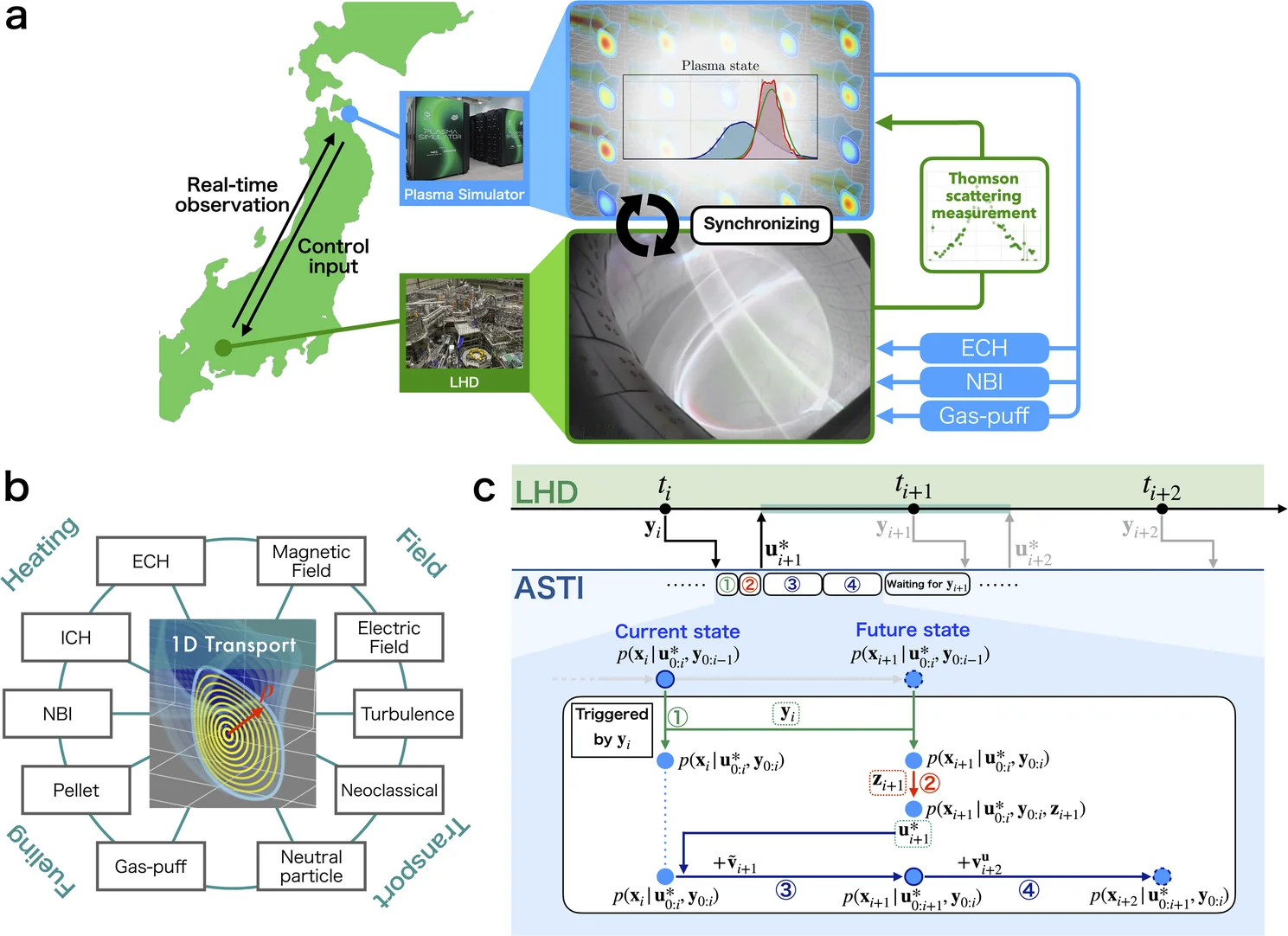
A digital twin helped steer LHD fusion plasmas toward target states in five tests
A Scientific Reports paper published 15 November 2026 describes a closed loop on Japan's Large Helical Device, with heating and fueling set from an adaptive, physics-based digital twin.
Energy
Halogen-free water-based electrolytes enable four-electron iodine batteries in the lab
A UCL-led Nature paper published 11 November 2026 reports aqueous zinc–iodine cells that retained 96% of their capacity after 1,000 cycles at 1 ampere per gram.
Energy
Certified 27.96% inverted perovskite cell, and 34.71% tandem output
A Xi’an Jiaotong University-led team reports conjugated interface molecules that raise certified laboratory efficiencies for inverted perovskite cells and perovskite-silicon tandems.