Certified 27.96% inverted perovskite cell, and 34.71% tandem output
A Xi’an Jiaotong University-led team reports conjugated interface molecules that raise certified laboratory efficiencies for inverted perovskite cells and perovskite-silicon tandems.
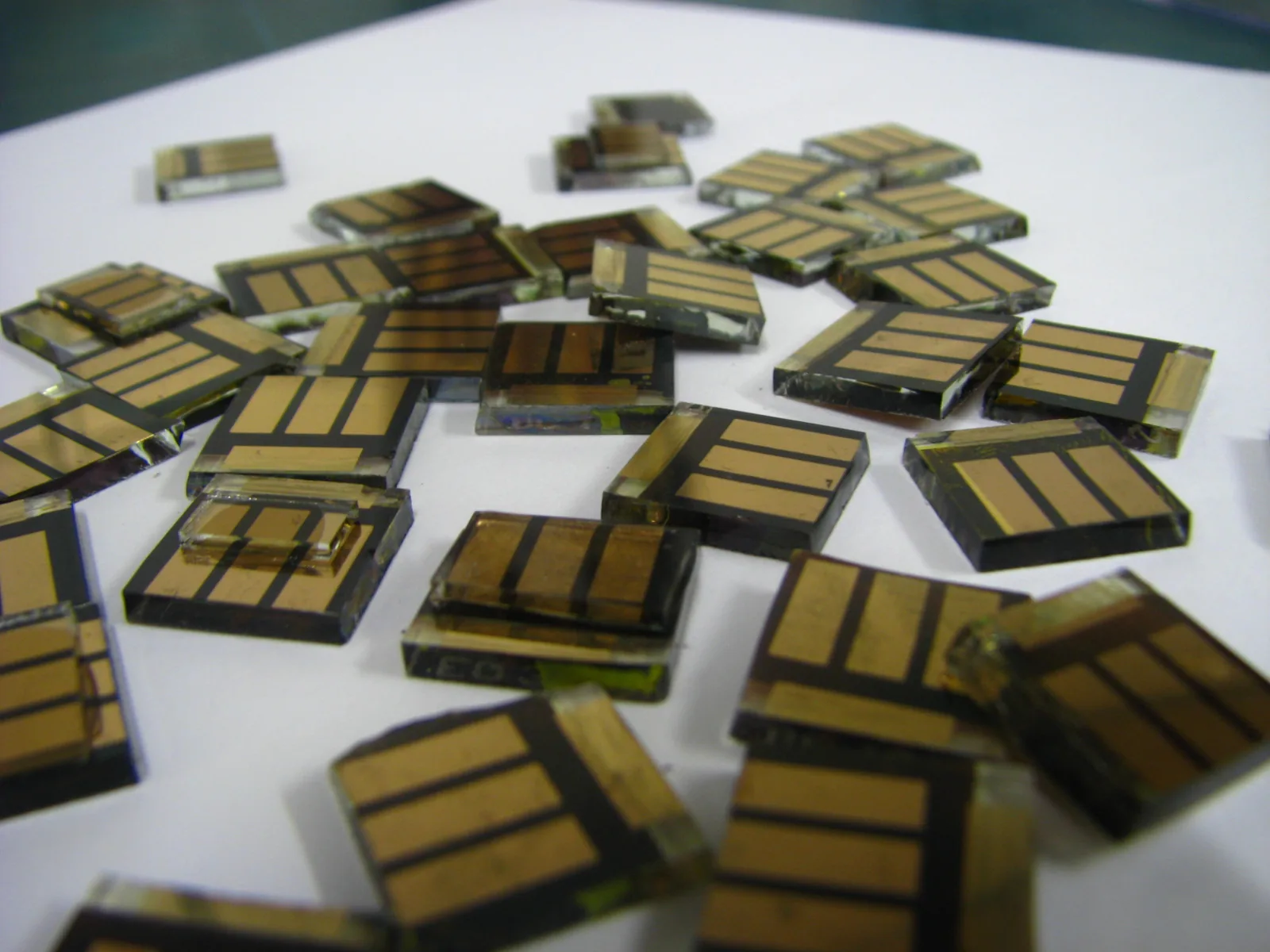
A team led by Xi’an Jiaotong University, with colleagues at the École Polytechnique Fédérale de Lausanne and other institutions, reports in Nature on 18 November 2026 a family of fully conjugated formamidinium molecules placed at the interface between a perovskite absorber and the electron-transport layer.
The authors argue that many conventional ammonium-based modifiers passivate surface defects but couple only weakly to the perovskite and can slow electron extraction. Their design is meant to extend the electronic band edge across that interface, so defects can be reduced without blocking the flow of charge. In inverted (p-i-n) laboratory cells, they report a certified power-conversion efficiency of 27.96% and a stabilized power output of 27.84%. Applied to a monolithic perovskite-silicon tandem, the same approach produced a certified stabilized output of 34.71%.
The devices also held up under a long laboratory stress test: after 2,000 hours of continuous maximum-power-point tracking under one-sun illumination, the cells retained more than 95% of their initial efficiency. Xi’an Jiaotong University, in a 19 November account of the work, said that test used unencapsulated single-junction cells under nitrogen at about 45 °C — not outdoor, encapsulated-module conditions. The results are from laboratory cells, not commercial modules, and neither the paper's abstract nor the university presents the figures as a formal record.
Why it matters
Losses at interfaces increasingly limit further efficiency gains in perovskite cells. A chemical design that passivates defects without getting in the way of electron extraction is directly relevant to both single-junction devices and tandems that sit on silicon, the workhorse of today's photovoltaics.
Looking ahead (speculative)
The next tests that would matter to manufacturers are larger-area devices, encapsulated modules, and outdoor operation. If those hold up, an interface layer of this kind could be one of the incremental improvements that help perovskites move from the lab bench toward production. That path is still unproven.