A digital twin helped steer LHD fusion plasmas toward target states in five tests
A Scientific Reports paper published 15 November 2026 describes a closed loop on Japan's Large Helical Device, with heating and fueling set from an adaptive, physics-based digital twin.
Listen
AI-generated voices, script based on this article · 3:56
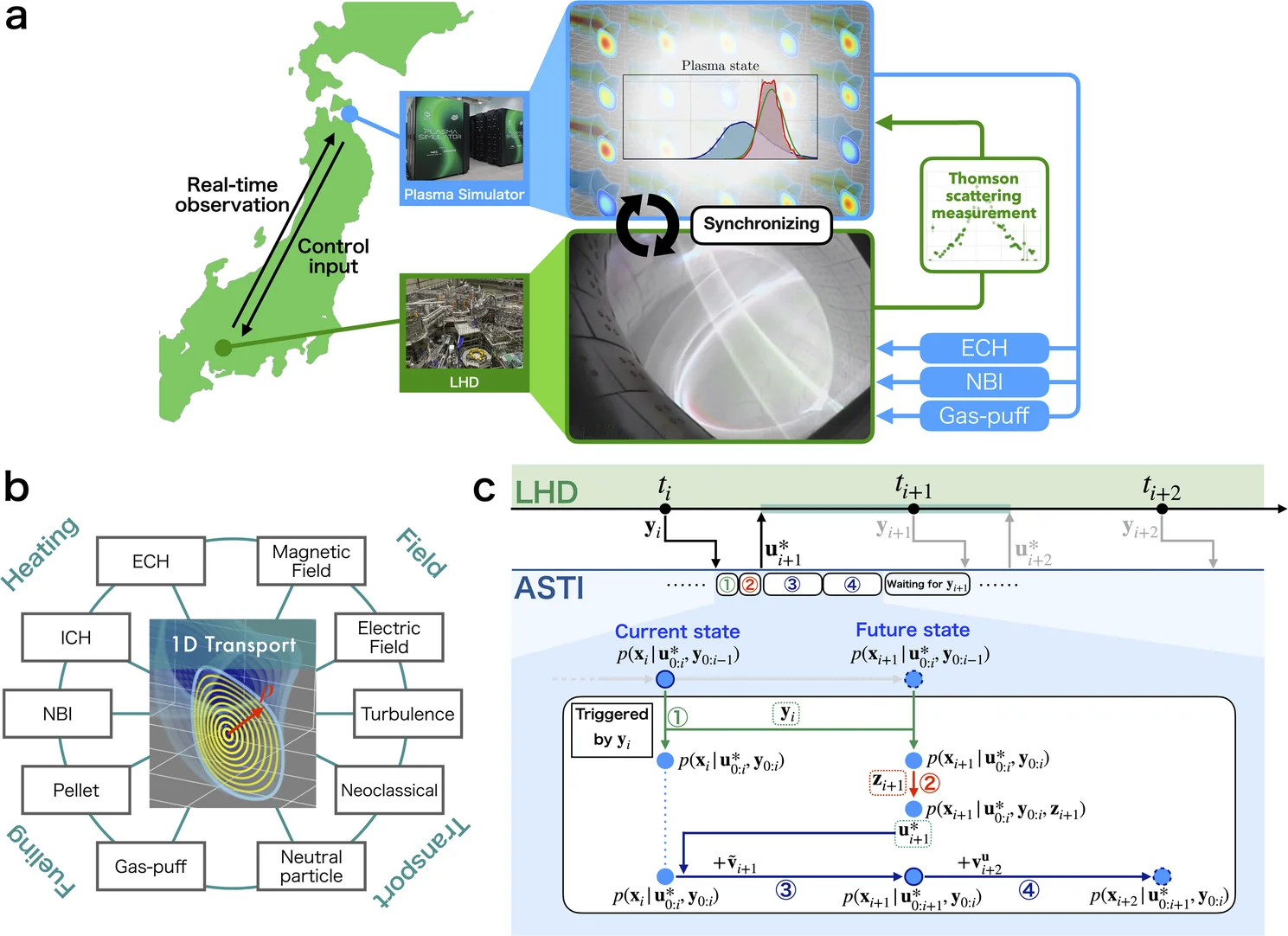
Scientific Reports published an open-access paper on 15 November 2026 in which Yuya Morishita and colleagues describe a closed control loop on the Large Helical Device (LHD), a research stellarator at the National Institute for Fusion Science in Toki, Japan. Corresponding author Morishita is at Kyoto University and the Institute of Statistical Mathematics. The team includes researchers at NIFS, SOKENDAI, and the Rokkasho Institute for Fusion Energy. The authors declare no competing interests. The journal's page presents the article as an early, citable version of a peer-reviewed paper that may still be edited before the final Version of Record.
Fusion plasmas have to be steered with several actuators at once, from incomplete measurements and with imperfect models. The authors built an adaptive digital twin that combines data assimilation with physics-based integrated modeling. The twin was kept in sync with experimental observations, and its predictions were used to set heating and fueling inputs intended to drive the plasma toward chosen targets.
The paper reports multivariate control of electron density, electron temperature, and ion temperature in five representative target cases. Real-time adaptation of the twin, and the estimation of those control inputs, were performed on a remote supercomputer about 1,000 kilometers from LHD, using up to 10,000 CPU cores. That is a statement about where the computation ran in the loop, not a claim that a power-producing reactor was piloted from a distance.
This is plasma-control research on a scientific stellarator, not a demonstration of a fusion power plant. The tests cover five target cases.
Why it matters
Keeping a model close enough to a live plasma that it can suggest the next heating and fueling step is a practical control problem, not only a simulation exercise. Showing that loop on LHD, including the use of a remote high-performance computer, gives other fusion laboratories a concrete example to test against.
Looking ahead (speculative)
The authors present the result as a route toward digital-twin control of future fusion reactors and of other partly observed systems. Whether the same approach will hold for longer pulses, more actuators, or reactor-relevant conditions is not shown here.
Sources
Sources
More in Energy
Energy
Entropy-tuned lead-free ceramic capacitors reach 21.5 J/cm³ in laboratory devices
A Nature Communications paper published 21 November 2026 reports laboratory multilayer ceramic capacitors, made from a lead-free high-entropy relaxor ferroelectric, with a recoverable energy-storage density of 21.5 joules per cubic centimeter at 1,200 kilovolts per centimeter.
Energy
Tailored interfaces push solid-state lithium-sulfur lab cells toward a projected 500 Wh/kg
A Nature Materials paper published 20 November 2026 reports sulfide-based all-solid-state lithium-sulfur cathodes with high areal capacity; the authors project pouch-cell energy densities above 500 watt-hours per kilogram.
Energy
Halogen-free water-based electrolytes enable four-electron iodine batteries in the lab
A UCL-led Nature paper published 11 November 2026 reports aqueous zinc–iodine cells that retained 96% of their capacity after 1,000 cycles at 1 ampere per gram.
Energy
Certified 27.96% inverted perovskite cell, and 34.71% tandem output
A Xi’an Jiaotong University-led team reports conjugated interface molecules that raise certified laboratory efficiencies for inverted perovskite cells and perovskite-silicon tandems.