A triple-interface catalyst draws hydrogen from neutral seawater under concentrated light
A 30 October 2026 Nature Synthesis paper reports a photocathode that reached about 100 milliamperes per square centimeter at 0 volts versus the reversible hydrogen electrode in neutral saline conditions.
Listen
AI-generated voices, script based on this article · 4:19
A Nature Synthesis paper published 30 October 2026 describes a catalyst of atomically dispersed Cr(OH)x clusters on platinum-decorated gallium nitride nanowires, designed for photoelectrochemical splitting of neutral seawater. Bingxing Zhang, Kejian Li and Zhuoran Long are co-first authors. Corresponding authors are Bingxing Zhang and Zetian Mi, of the University of Michigan; Deming Xia, of the University of Pennsylvania; and Victor S. Batista, of Yale University.
The authors write that a triple-interface architecture — Cr(OH)x–Pt, Cr(OH)x–GaN and Pt–GaN — couples water activation, hydrogen transfer and Pt–H formation, a process they describe as hydrogen pumping. According to the abstract, the photocathode reached a photocurrent density of about 100 milliamperes per square centimeter and ran for more than 50 hours under neutral saline conditions with concentrated sunlight, at 0 volts versus the reversible hydrogen electrode. In a separate, hydrazine-assisted seawater photoelectrolyzer, the same photocathode enabled a bias-free photocurrent density of about 70 milliamperes per square centimeter.
The work is a laboratory photoelectrochemical study. The headline current density was measured under concentrated sunlight, and the hydrazine-assisted result is a different chemical condition from unassisted seawater splitting. Some intellectual property related to the work has been licensed to NX Fuels, Inc., which was co-founded by Mi; the University of Michigan and Mi have a financial interest in the company, the paper states.
Why it matters
Neutral seawater is abundant, but splitting it is often slow because hydrogen is hard to supply and move to catalytic sites. A catalyst architecture that, in this experiment, produces high photocurrent at 0 volts under concentrated light shows a way to manage that hydrogen transfer at adjacent interfaces.
Looking ahead (speculative)
If similar current densities can be reached under one-sun outdoor conditions, and if the system remains stable well beyond 50 hours without hydrazine, the approach could be tested as a more practical seawater-to-hydrogen device. Those conditions are not reported here.
Sources
Sources
More in Energy
Energy
Entropy-tuned lead-free ceramic capacitors reach 21.5 J/cm³ in laboratory devices
A Nature Communications paper published 21 November 2026 reports laboratory multilayer ceramic capacitors, made from a lead-free high-entropy relaxor ferroelectric, with a recoverable energy-storage density of 21.5 joules per cubic centimeter at 1,200 kilovolts per centimeter.
Energy
Tailored interfaces push solid-state lithium-sulfur lab cells toward a projected 500 Wh/kg
A Nature Materials paper published 20 November 2026 reports sulfide-based all-solid-state lithium-sulfur cathodes with high areal capacity; the authors project pouch-cell energy densities above 500 watt-hours per kilogram.
Energy
A digital twin helped steer LHD fusion plasmas toward target states in five tests
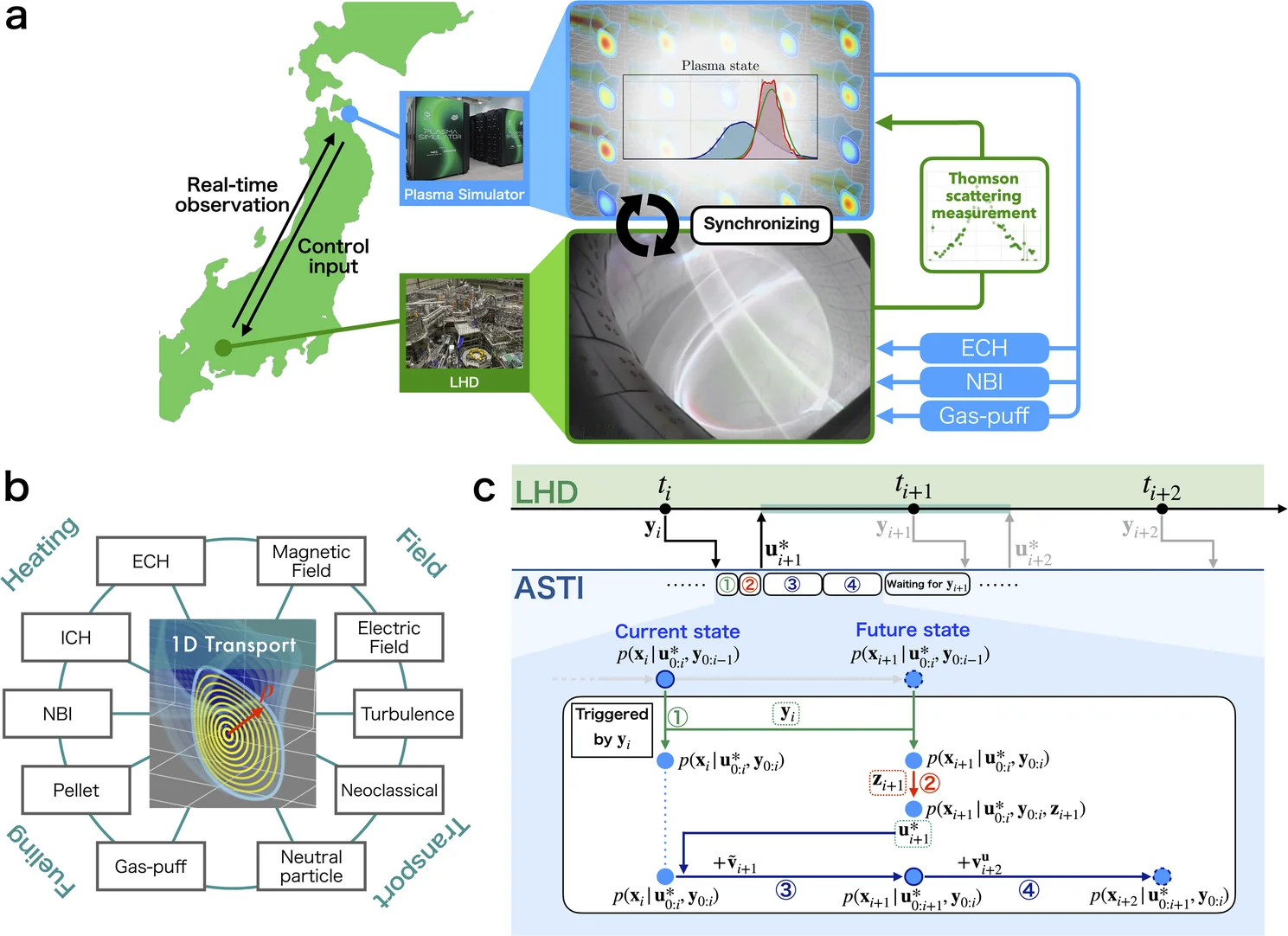
A Scientific Reports paper published 15 November 2026 describes a closed loop on Japan's Large Helical Device, with heating and fueling set from an adaptive, physics-based digital twin.
Energy
Halogen-free water-based electrolytes enable four-electron iodine batteries in the lab
A UCL-led Nature paper published 11 November 2026 reports aqueous zinc–iodine cells that retained 96% of their capacity after 1,000 cycles at 1 ampere per gram.