A solution-processed organic sheet splits water with simulated sunlight and no bias
An 11 November 2026 Nature Energy study from EPFL reports unassisted water splitting for more than two hours at a stabilized hydrogen rate of 1.3 micromoles per hour per square centimeter, or 0.1% solar-to-hydrogen efficiency.
Listen
AI-generated voices, script based on this article · 4:03
A Nature Energy paper published 11 November 2026 describes a photocatalyst sheet in which a single solution-processed organic semiconductor layer evolves either hydrogen or oxygen, depending only on the molecular contact underneath it. Nicolas J. Diercks and Jin Su Park of EPFL's Laboratory for Molecular Engineering of Optoelectronic Nanomaterials are co-first authors. The corresponding author is Kevin Sivula, of the same laboratory, with collaborators at EPFL's Laboratory of Photonic Materials and Fiber Devices and at the Ulsan National Institute of Science and Technology. The article is open access under a Creative Commons Attribution 4.0 license.
According to the paper's abstract, the organic film is deposited as a bulk heterojunction blend. Patterning both contacts as microdomains on one substrate produced a sheet that achieved unassisted water splitting under simulated sunlight for more than two hours and generated hydrogen at a stabilized rate of 1.3 micromoles per hour per square centimeter, corresponding to a solar-to-hydrogen conversion efficiency of 0.1%. An official EPFL account of the study the same day says the sheet produced hydrogen and oxygen in the expected 2:1 ratio, and that the efficiency is still too low for practical application. The demonstration lasted hours, under simulated sunlight, not months outdoors.
Why it matters
Most photocatalyst sheets have used inorganic semiconductor particles that are hard to process as a large film. A solution-processed organic layer that can be switched between hydrogen and oxygen evolution by changing only the underlayer offers a simpler way to print both half-reactions on one substrate — if the efficiency can be raised.
Looking ahead (speculative)
The EPFL team points to narrower-bandgap acceptors, better charge-selective molecules and more selective co-catalyst deposition as next steps. Those changes have not been shown to bring the 0.1% efficiency into a practical range.
Sources
Sources
More in Energy
Energy
Entropy-tuned lead-free ceramic capacitors reach 21.5 J/cm³ in laboratory devices
A Nature Communications paper published 21 November 2026 reports laboratory multilayer ceramic capacitors, made from a lead-free high-entropy relaxor ferroelectric, with a recoverable energy-storage density of 21.5 joules per cubic centimeter at 1,200 kilovolts per centimeter.
Energy
Tailored interfaces push solid-state lithium-sulfur lab cells toward a projected 500 Wh/kg
A Nature Materials paper published 20 November 2026 reports sulfide-based all-solid-state lithium-sulfur cathodes with high areal capacity; the authors project pouch-cell energy densities above 500 watt-hours per kilogram.
Energy
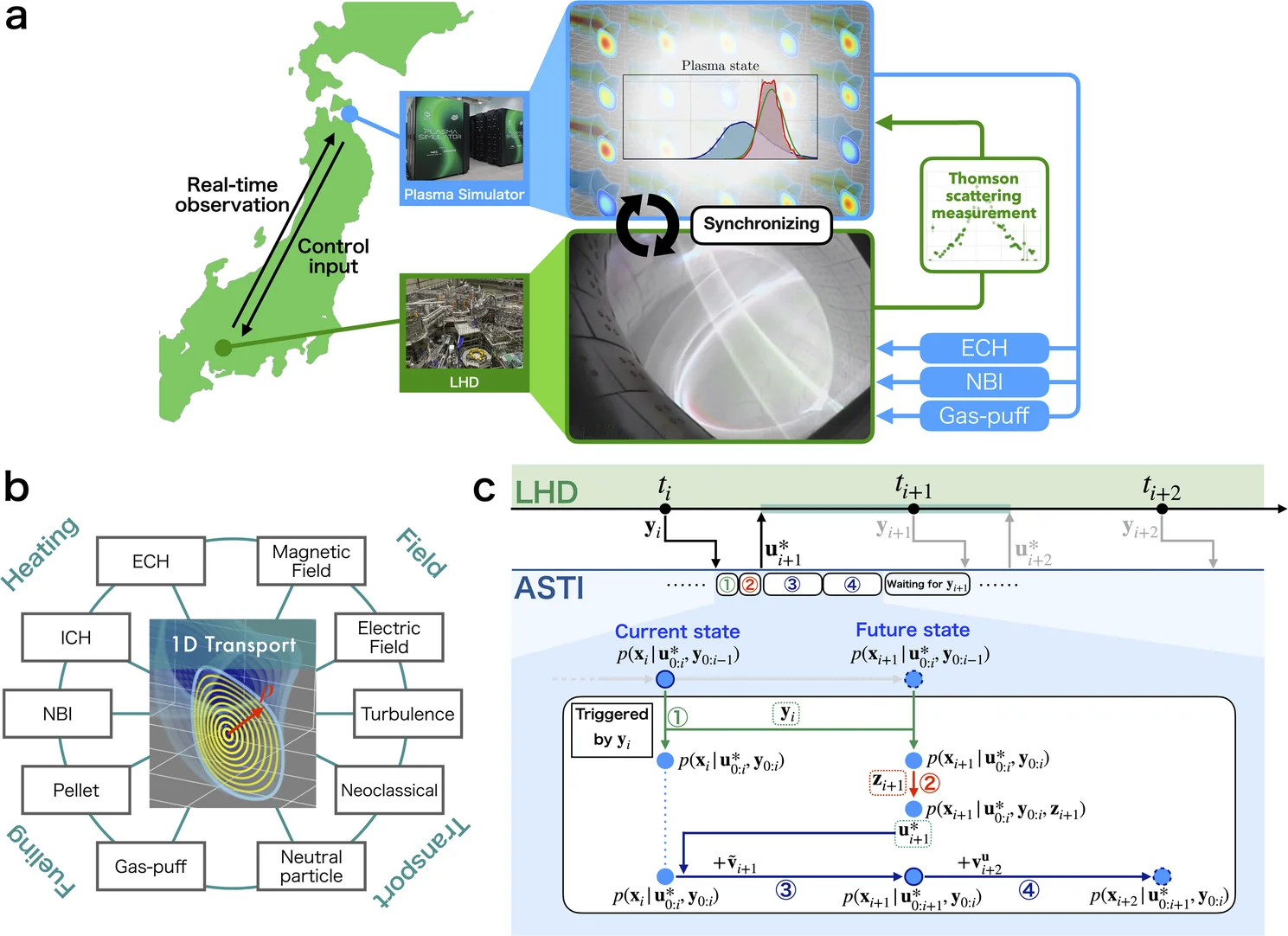
A digital twin helped steer LHD fusion plasmas toward target states in five tests
A Scientific Reports paper published 15 November 2026 describes a closed loop on Japan's Large Helical Device, with heating and fueling set from an adaptive, physics-based digital twin.
Energy
Halogen-free water-based electrolytes enable four-electron iodine batteries in the lab
A UCL-led Nature paper published 11 November 2026 reports aqueous zinc–iodine cells that retained 96% of their capacity after 1,000 cycles at 1 ampere per gram.