An O6 stacking sequence steadies oxygen-redox lithium-rich cathodes in lab cells
A 20 November 2026 Nature Sustainability paper from Seoul National University reports lithium-rich layered oxides whose O6-type structure, the authors say, yields negligible voltage decay.
Listen
AI-generated voices, script based on this article · 3:46
A Nature Sustainability paper published 20 November 2026 reports a family of lithium-rich layered cathode materials, Lix(Li0.15Ni0.20Mn0.65)O2, with an O6-type stacking sequence formed by an atomic-scale intergrowth of O3- and O1-type subunit cells. Seongmin Kang, Sung-O Park and Ho-Young Jang are co-first authors. The corresponding author is Kisuk Kang of the Department of Materials Science and Engineering at Seoul National University, with collaborators including Stefan A. Freunberger at the Institute of Science and Technology Austria.
Oxygen-redox chemistry in lithium-rich layered oxides can add capacity, but irreversible structural changes often cause progressive voltage decay. Combining first-principles calculations with structural and spectroscopic analyses, the authors write that the intergrown O6 architecture suppressed transition-metal migration and irreversible oxygen dimerization, preserving the local oxygen coordination during cycling. Consequently, they report, the O6-type cathode showed negligible voltage decay and superior energy-density retention.
The results come from laboratory cells. The paper does not present a commercial cell or pack.
Why it matters
Voltage fade has been a stubborn limit on lithium-rich cathodes that try to use oxygen redox for extra energy. A stacking sequence that, in this study, keeps that extra capacity more reversible gives battery chemists a structural handle — atomic-scale packing — rather than only a change in composition.
Looking ahead (speculative)
If the same O6 framework still suppresses voltage decay under the thicker electrodes, higher rates and electrolyte conditions used in practical cells, it could become a design route for longer-lived, higher-energy cathodes. Those conditions have not been established as a commercial test in this paper.
Sources
Sources
More in Energy
Energy
Entropy-tuned lead-free ceramic capacitors reach 21.5 J/cm³ in laboratory devices
A Nature Communications paper published 21 November 2026 reports laboratory multilayer ceramic capacitors, made from a lead-free high-entropy relaxor ferroelectric, with a recoverable energy-storage density of 21.5 joules per cubic centimeter at 1,200 kilovolts per centimeter.
Energy
Tailored interfaces push solid-state lithium-sulfur lab cells toward a projected 500 Wh/kg
A Nature Materials paper published 20 November 2026 reports sulfide-based all-solid-state lithium-sulfur cathodes with high areal capacity; the authors project pouch-cell energy densities above 500 watt-hours per kilogram.
Energy
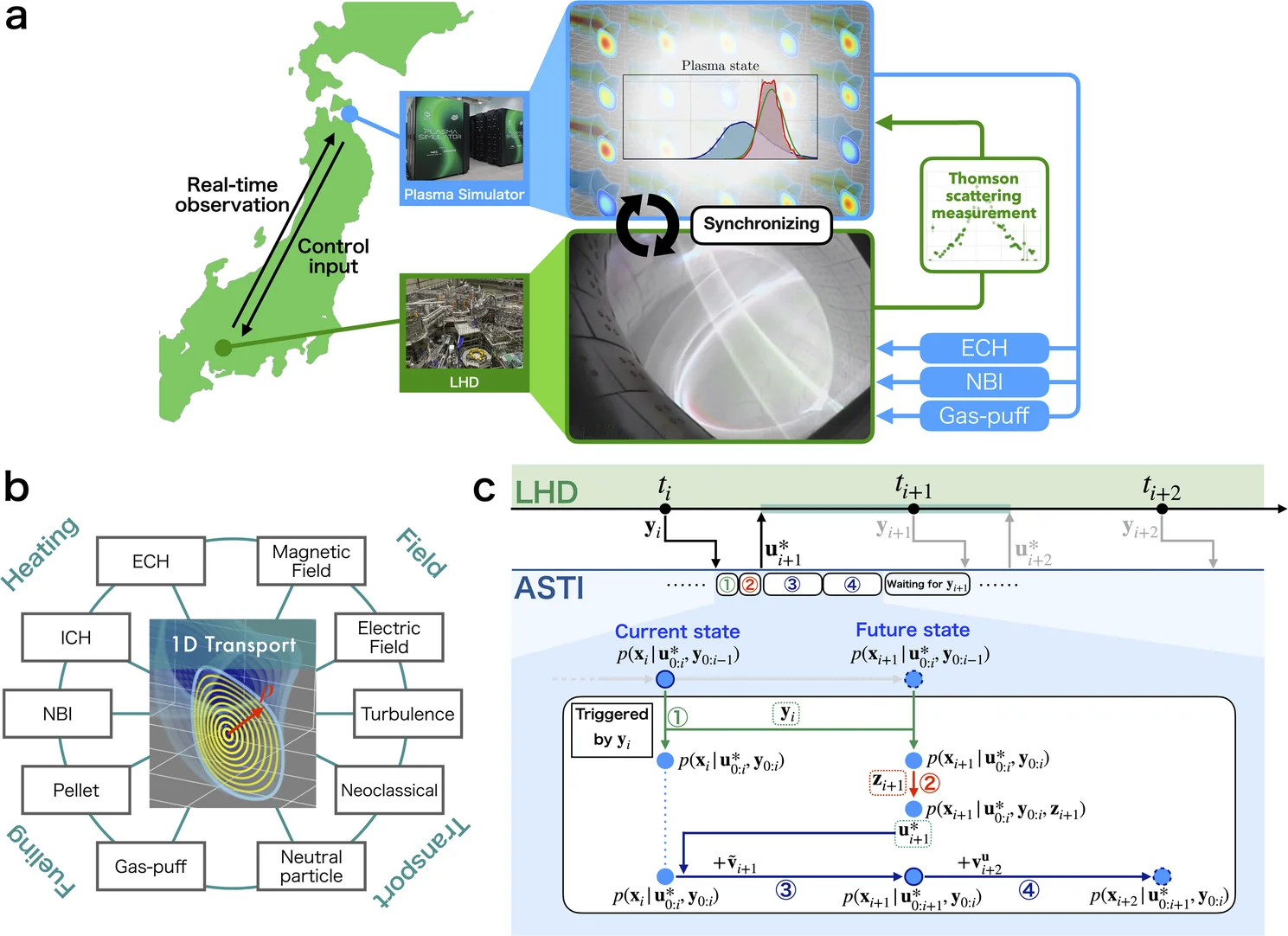
A digital twin helped steer LHD fusion plasmas toward target states in five tests
A Scientific Reports paper published 15 November 2026 describes a closed loop on Japan's Large Helical Device, with heating and fueling set from an adaptive, physics-based digital twin.
Energy
Halogen-free water-based electrolytes enable four-electron iodine batteries in the lab
A UCL-led Nature paper published 11 November 2026 reports aqueous zinc–iodine cells that retained 96% of their capacity after 1,000 cycles at 1 ampere per gram.