An AI system designs metal-organic frameworks, and four are made in the lab
A Nature Computational Science paper published 20 November 2026 describes MOFGen, an agentic system that generated hundreds of thousands of metal-organic framework structures; high-throughput experiments then produced four of the authors' "AI-dreamt" MOFs.
Listen
AI-generated voices, script based on this article · 4:12
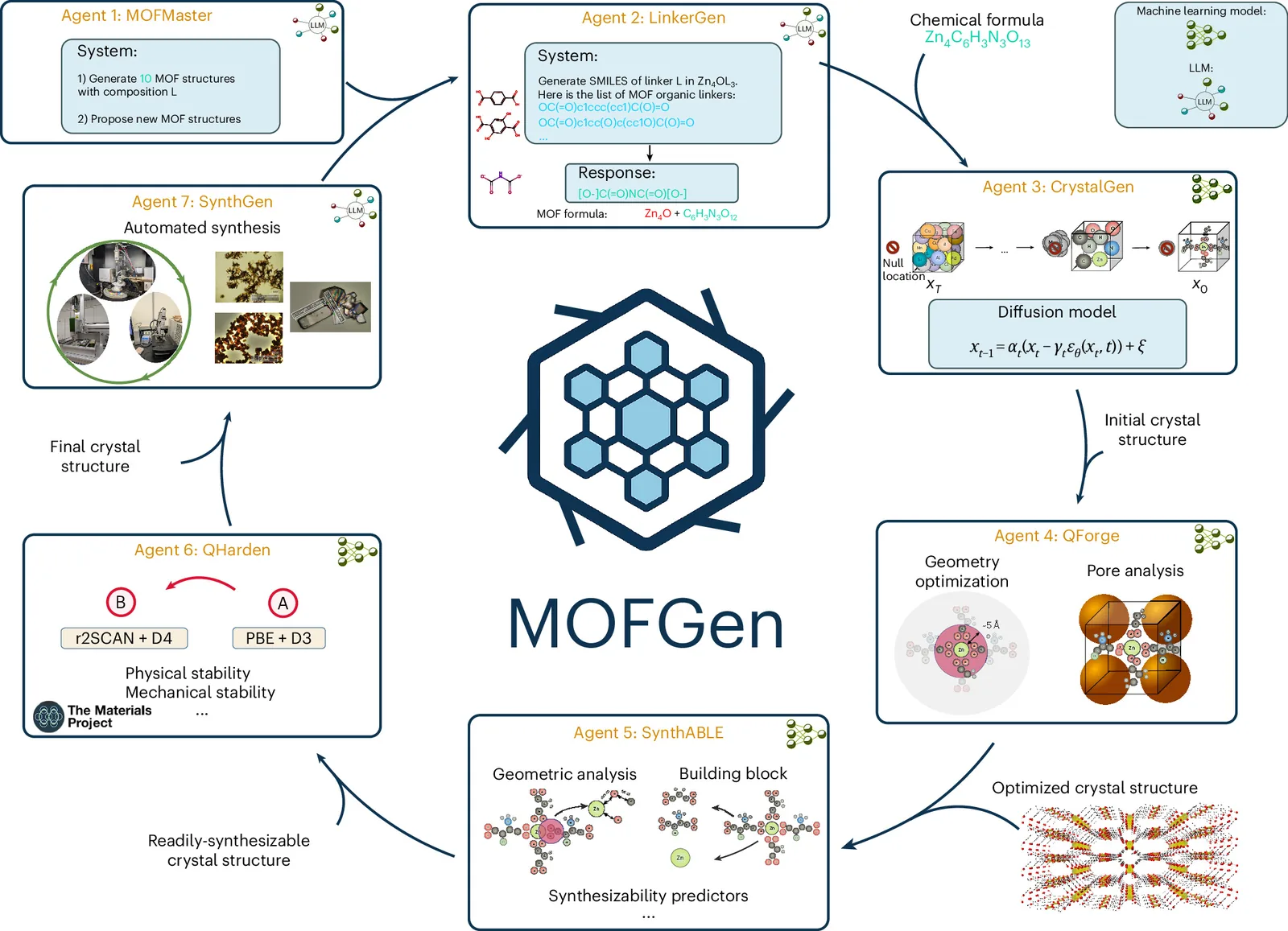
Nature Computational Science published an open-access paper on 20 November 2026 in which Théo Jaffrelot Inizan, Sherry Yang, Aaron Kaplan, Yen-hsu Lin, and colleagues describe MOFGen, a system of linked software agents that proposes metal-organic framework (MOF) compositions, generates crystal structures, and filters them with quantum-mechanical and synthesizability checks. Corresponding authors are Inizan, Kristin A. Persson, and Omar M. Yaghi. The team is based at the University of California, Berkeley, Lawrence Berkeley National Laboratory, and partner institutes; Yang and Ekin Dogus Cubuk are at Google DeepMind. The authors declare no competing interests.
The work is aimed at problems such as carbon dioxide capture and water harvesting, but those applications are the motivation, not a performance result reported here. An interface agent, MOFMaster, can request structures with or without a specified metal building unit or composition. LinkerGen proposes chemical formulae; CrystalGen, a composition-conditioned diffusion model, builds all-atom crystal structures; further agents optimize and filter the candidates and score the likelihood that they can be made.
The authors write that MOFGen generated hundreds of thousands of MOF structures, including large frameworks with atomic precision. After optimization and filtering, they released a dataset of 178,189 diffusion-generated MOFs. A later ranking step narrowed the list to 349 high-confidence organic linkers for high-throughput experiments. From that set, the team reports the successful synthesis of four "AI-dreamt" MOFs, characterized by powder or single-crystal X-ray diffraction. To raise the chance of success, experimental validation was deliberately focused on zinc-based MOFs, and the current system still relies on a human in the loop for synthesis.
This is an open-access computational-plus-laboratory study. Hundreds of thousands of structures were generated; only four have been synthesized so far. The paper does not demonstrate industrial carbon dioxide-capture or water-harvesting performance.
Why it matters
Generative models can propose huge numbers of porous crystals, but most never leave the computer. Showing that a filtered subset can be made in the lab, even if only four zinc-based frameworks so far, is a concrete step from generated structures to characterized materials.
Looking ahead (speculative)
The authors present MOFGen as a modular route toward tighter coupling with automated synthesis and, later, structures aimed at particular properties. Whether that pipeline can move beyond zinc-based cases, or into working capture and harvesting materials, is not shown here.
Sources
Sources
More in AI
AI
A generative model maps catalyst adsorption geometries without energy or force labels
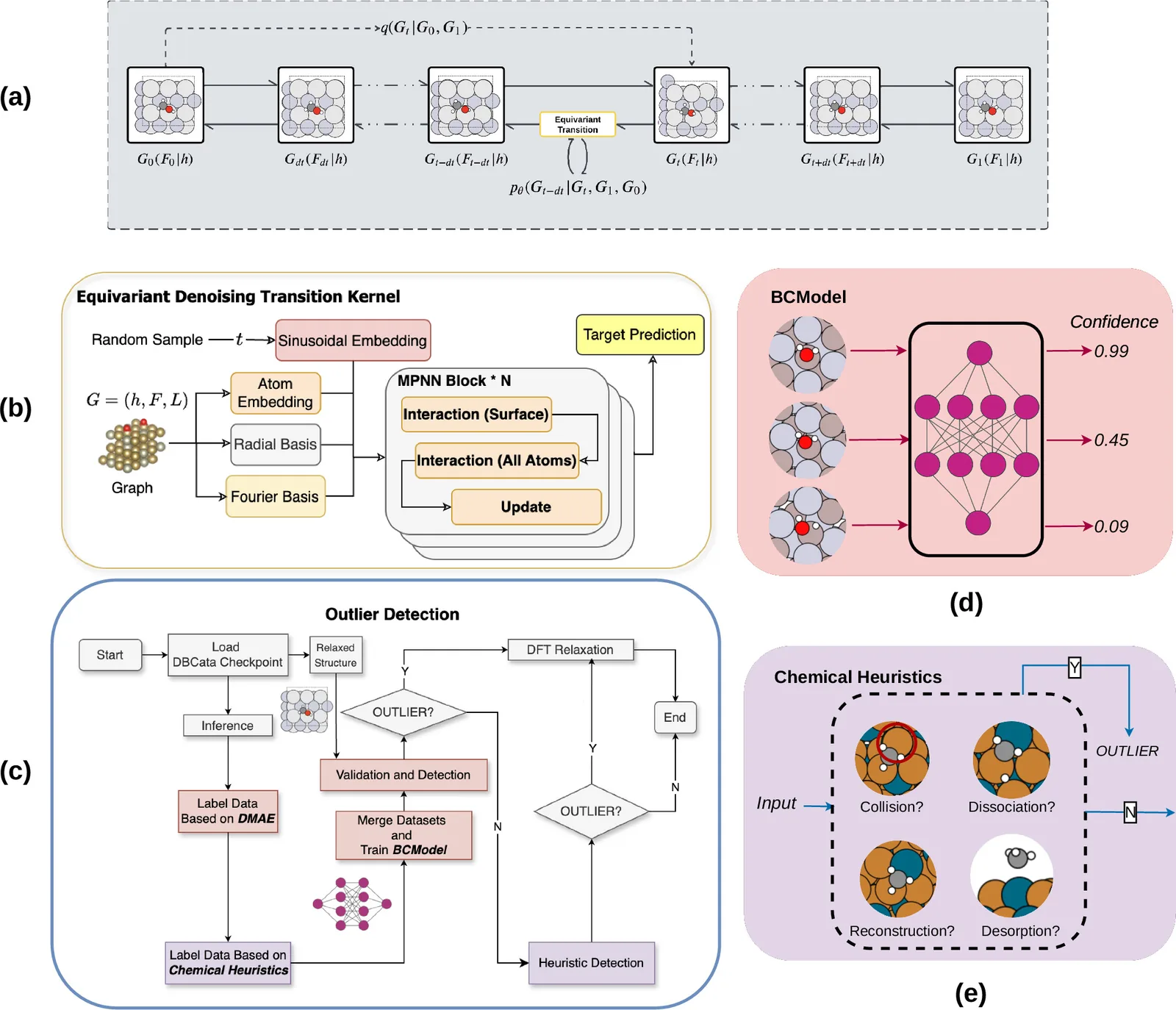
A Nature Communications paper published 21 November 2026 describes DBCata, a generative model that produces near-equilibrium adsorption structures without energy or force labels and uses it for computational screening of alloy oxygen-reduction catalysts.
AI
A Google and Johns Hopkins agent reports a 76% MLE-Bench medal rate in a preprint
A 19 November 2026 arXiv preprint describes Pro² Agent, which the authors say matched the best reported 24-hour medal rate on the full MLE-Bench and reached 76.0% with a 48-hour budget.
AI
Medical vision-language model ties diagnoses to pixel-level visual evidence
A 29 October 2026 Nature Medicine paper introduces EVLF-FM, developed and tested on more than 1.3 million samples across 10 imaging modalities, with prospective trials still required before clinical use.
AI
AI agents write quantum programs that check out in a formal proof system, Google teams report
A 6 November 2026 preprint (revised 16 November) from Google DeepMind and Google Quantum AI describes Gemini 4 agents that produce Lean-verified programs and, the authors say, lower estimated resource costs.