A generative model maps catalyst adsorption geometries without energy or force labels
A Nature Communications paper published 21 November 2026 describes DBCata, a generative model that produces near-equilibrium adsorption structures without energy or force labels and uses it for computational screening of alloy oxygen-reduction catalysts.
Listen
AI-generated voices, script based on this article · 4:05
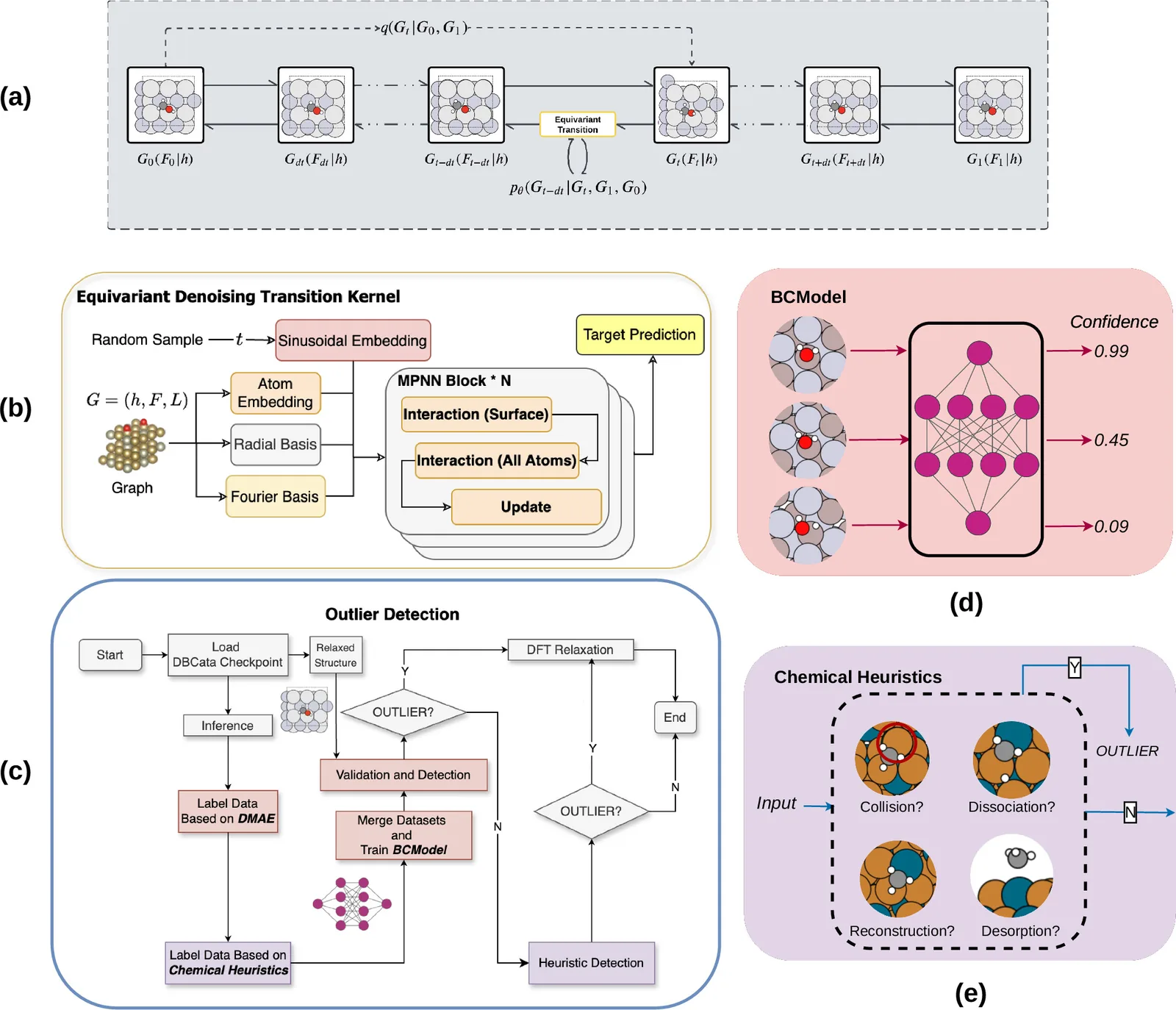
Nature Communications published an open-access paper on 21 November 2026 in which Songze Huo and Xiao-Ming Cao describe DBCata, a deep generative model that maps unrelaxed catalyst adsorption structures to density-functional-theory-relaxed geometries without energy or force labels. Corresponding author Cao, and Huo, are at the State Key Laboratory of Synergistic Chem-Bio Synthesis, School of Chemistry and Chemical Engineering, Shanghai Jiao Tong University. All authors declare no competing interests.
The authors write that adsorption energy is a central descriptor for large-scale catalyst screening, but that machine-learning interatomic potentials, trained mainly on near-equilibrium structures, can give unreliable adsorption structures and, with them, unreliable energy predictions. DBCata combines a periodic Brownian-bridge framework with an equivariant graph neural network to learn a low-dimensional transition between unrelaxed and DFT-relaxed structures.
On the MamunHighT2019 dataset from Catalysis-Hub, the authors report an interatomic-distance mean absolute error of 0.035 Å, which they say is approximately 70% lower than that of the current state-of-the-art machine-learning potential models. After a hybrid chemical-heuristic and self-supervised outlier-detection step that identifies and refines anomalous predictions, they report that the corresponding DFT accuracy falls within 0.1 eV in 94% of instances. They then use DBCata for high-throughput computational screening of alloy catalysts for the oxygen reduction reaction, and they write that the model enables accelerated screening.
This is an open-access computational study, not an experimental laboratory demonstration of a new catalyst. The paper is an accelerated article preview: a peer-reviewed, accepted version that the journal shared early and that is subject to further edits before the final version of record.
Why it matters
Screening catalysts often means relaxing many adsorption geometries, a step that is costly if every structure has to be treated at the DFT level or handed to a potential trained mainly on near-equilibrium examples. A generative model that proposes near-equilibrium geometries without energy or force labels, and that the authors then apply to a computational oxygen-reduction screen, is a concrete test of that shortcut.
Looking ahead (speculative)
The authors present DBCata as a tool for catalyst design and optimization. Whether it will change how experimental catalyst libraries are chosen is not shown here.
Sources
Sources
More in AI
AI
An AI system designs metal-organic frameworks, and four are made in the lab
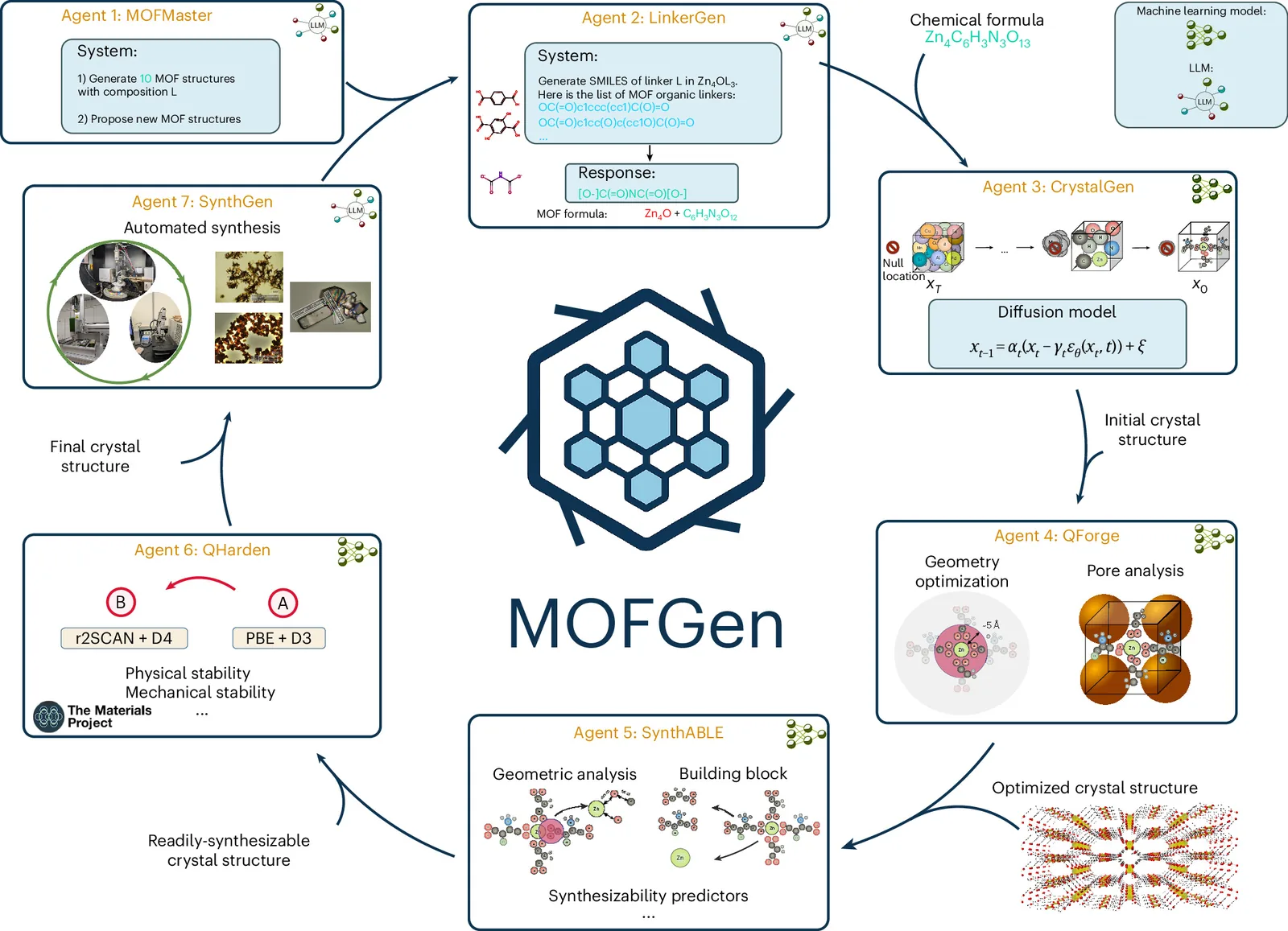
A Nature Computational Science paper published 20 November 2026 describes MOFGen, an agentic system that generated hundreds of thousands of metal-organic framework structures; high-throughput experiments then produced four of the authors' "AI-dreamt" MOFs.
AI
A Google and Johns Hopkins agent reports a 76% MLE-Bench medal rate in a preprint
A 19 November 2026 arXiv preprint describes Pro² Agent, which the authors say matched the best reported 24-hour medal rate on the full MLE-Bench and reached 76.0% with a 48-hour budget.
AI
Medical vision-language model ties diagnoses to pixel-level visual evidence
A 29 October 2026 Nature Medicine paper introduces EVLF-FM, developed and tested on more than 1.3 million samples across 10 imaging modalities, with prospective trials still required before clinical use.
AI
AI agents write quantum programs that check out in a formal proof system, Google teams report
A 6 November 2026 preprint (revised 16 November) from Google DeepMind and Google Quantum AI describes Gemini 4 agents that produce Lean-verified programs and, the authors say, lower estimated resource costs.