Boston Dynamics announces a second-generation Stretch trailer-unloading robot
In a 3 November 2026 product release, the company describes Stretch Gen 2 as an industrial upgrade based on what it says is data from more than 100,000 operating hours.
Listen
AI-generated voices, script based on this article · 3:51
On 3 November 2026, Boston Dynamics announced Stretch Gen 2, a new version of its autonomous mobile robot for unloading trailers. The announcement is a company product release, not a peer-reviewed study, and the performance figures below are Boston Dynamics' own claims.
The company says the new design draws on data from more than 100,000 operating hours and tens of millions of boxes. It reports 81% less internal cabling than the prior generation, a swerve-drive module that can be swapped in about an hour rather than a full day, a throughput of up to 1,000 cases per hour that it says depends heavily on case weight and stacking, a battery intended to last two shifts, and a charge to 90% in about 75 minutes.
Stretch Gen 2 is an industrial trailer-unloading machine, not a general-purpose humanoid. Boston Dynamics presents the update as a maintenance and reliability upgrade for a robot already used to unload trailers, rather than as a new class of machine. The release does not independently verify the reliability or throughput figures, and those numbers should be read as the manufacturer's specifications.
Why it matters
Unloading trailers is repetitive, physically demanding warehouse work. A more serviceable, higher-throughput unloading robot, if the company's figures are borne out in customer sites, would be a practical change in that narrow job — not a claim about robots replacing warehouse work in general.
Looking ahead (speculative)
Customers and third-party tests will be the real check on cabling, swap times and cases per hour. Until those reports appear, the launch is best treated as a vendor announcement of an incremental industrial upgrade.
Sources
Sources
More in Robotics
Robotics
A humanoid copies whole-body motion from live monocular video, according to a preprint
A 15 November 2026 arXiv paper from the University of Hong Kong and collaborators describes MoViC, which drives a humanoid from a live RGB camera feed without wearable trackers.
Robotics
Soft, bioinspired robot travels two meters through a pig small intestine
A 28 October 2026 Science Robotics study from MIT and collaborators reports a tethered enteroscopic robot that imaged, biopsied and delivered fluid in animal tests.
Robotics
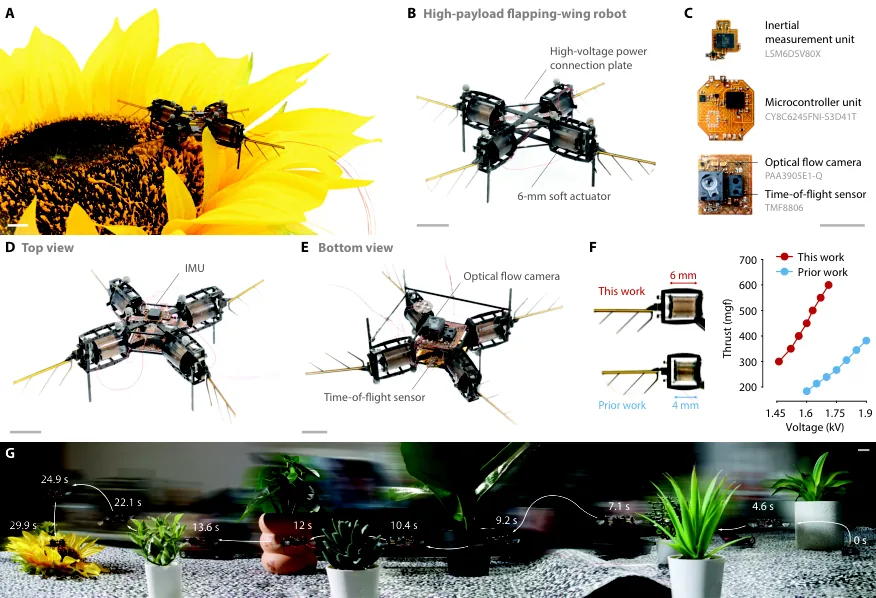
Insect-scale flying robot navigates with its own sensors and computer
MIT and Cornell researchers describe a flapping-wing microrobot that can follow trajectories and land on a sunflower without a lab motion-capture system.
Robotics
Legged robot completes kilometer-scale alpine and campus routes with a vision-language controller
ETH Zurich and Apple researchers report in Science Robotics on 18 November 2026 a system, ROAM, that combines a vision-language model with learned locomotion for navigation in unstructured terrain.