Insect-scale flying robot navigates with its own sensors and computer
MIT and Cornell researchers describe a flapping-wing microrobot that can follow trajectories and land on a sunflower without a lab motion-capture system.
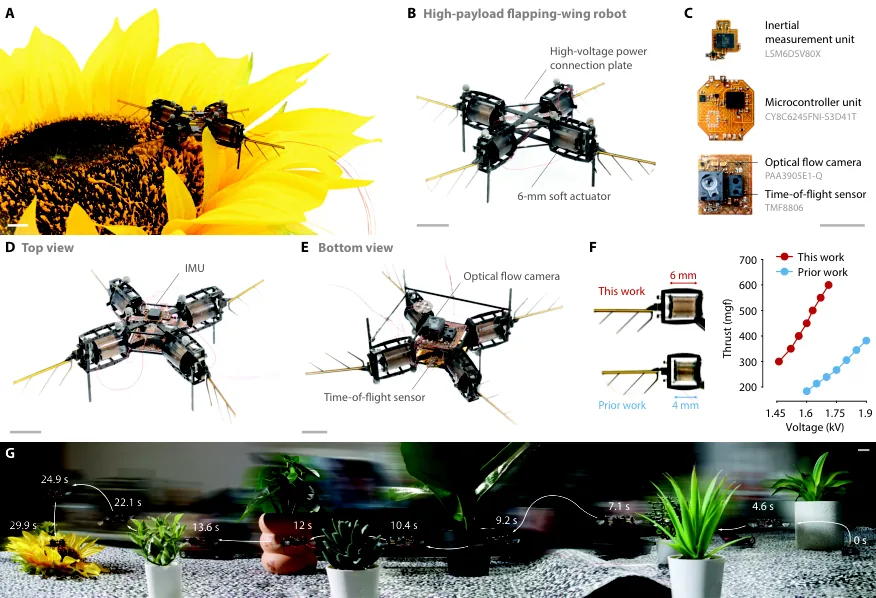
Researchers at MIT and Cornell report in Science Robotics on 18 November 2026 a 1.29-gram flapping-wing robot that can hover and follow trajectories using only the sensors and computer it carries. Until now, aerial microrobots this small have typically depended on external motion-capture systems in the laboratory, because they could not lift the electronics needed to estimate their own motion.
The robot carries a 244-milligram electronics package with an inertial measurement unit, an optical-flow sensor, a time-of-flight height sensor, and a microcontroller. According to MIT News, published the same day, the team enlarged the soft artificial muscles that flap the wings enough to reach a lift-to-weight ratio of 1.9, leaving payload capacity for that package. An open preprint of the paper reports 3.96-centimeter root-mean-square positional error on hovering and trajectory-tracking flights; MIT News describes the errors as only a few centimeters.
The system is still a laboratory prototype. The robot remains connected to an offboard power source, and untethered flight with onboard batteries has not been shown. In a 30-second flight outside the motion-capture arena, a human operator sent high-level position commands while the onboard controller kept the vehicle stable; the robot avoided obstacles and landed on a sunflower. The team says it is now working on an onboard camera for object recognition and on packing power electronics and batteries onto the airframe.
Why it matters
Onboard sensing is a necessary step if insect-scale flyers are ever to leave the lab for jobs such as close-range crop inspection. Earlier machines in this size class could fly with agility, but only while a roomful of cameras told them where they were.
Looking ahead (speculative)
If the group can add a camera and a battery without giving up stability, flights in greenhouses or cluttered indoor spaces become a more realistic research target. That is still a prototype goal, not a product timeline, and the extra mass of a battery remains a central engineering constraint.
Sources
Sources
- Hsiao, Kieu, Guan et al., Controlled flight of an insect-scale flapping-wing robot via integrated onboard sensing and computation, Science Robotics, 18 November 2026
- Open preprint of the same study, arXiv:2602.08328
- This featherweight, flying robot carries its own sensors and computers, MIT News, 18 November 2026