Legged robot completes kilometer-scale alpine and campus routes with a vision-language controller
ETH Zurich and Apple researchers report in Science Robotics on 18 November 2026 a system, ROAM, that combines a vision-language model with learned locomotion for navigation in unstructured terrain.
Listen
AI-generated voices, script based on this article · 3:35
Takahiro Miki, Marco Hutter and colleagues at ETH Zurich, with Matthias Müller at Apple, report in Science Robotics on 18 November 2026 a system they call ROAM (Robust Open-world Autonomous Mobility). It combines a vision-language model, which the authors use to label what the robot sees and to assign navigation risk, with locomotion and local-navigation policies trained in simulation by reinforcement learning.
The published abstract says the robot completed kilometer-long hikes with minimal intervention, interpreted signs to avoid danger and identified safer ground on which to step. In an open preprint of the study, the authors report a 1.2-kilometer course on ETH's Hönggerberg campus in which the robot took detours around road-work and construction signs and a mannequin, as well as alpine hikes of 10.1 kilometers near Zermatt and 2.38 kilometers at Seealpsee.
The system is a field-research prototype, not a commercial product. The authors themselves note remaining challenges in the reliability and spatial reasoning of vision-language models, and they present foundation models as a component, not a complete solution for navigation in the wild. The preprint also records where people had to step in: two major human interventions on the Zermatt hike, both near construction zones (the robot was autonomous 96.7% of the time), and several operator interventions at Seealpsee.
Why it matters
Legged robots can already walk over rough ground when a person drives them. Deciding where it is safe to walk — and when a sign should close a path — is a different problem. A controller that uses a vision-language model for that judgment, if its field results hold up, would be a step toward less teleoperated outdoor robots.
Looking ahead (speculative)
Wider testing on new trails, weather and signage will show how often the system still needs a human to intervene. Until those limits are clearer, ROAM is best read as a research demonstration on specific Swiss routes, not as a general off-road autopilot.
Sources
Sources
More in Robotics
Robotics
A humanoid copies whole-body motion from live monocular video, according to a preprint
A 15 November 2026 arXiv paper from the University of Hong Kong and collaborators describes MoViC, which drives a humanoid from a live RGB camera feed without wearable trackers.
Robotics
Soft, bioinspired robot travels two meters through a pig small intestine
A 28 October 2026 Science Robotics study from MIT and collaborators reports a tethered enteroscopic robot that imaged, biopsied and delivered fluid in animal tests.
Robotics
Insect-scale flying robot navigates with its own sensors and computer
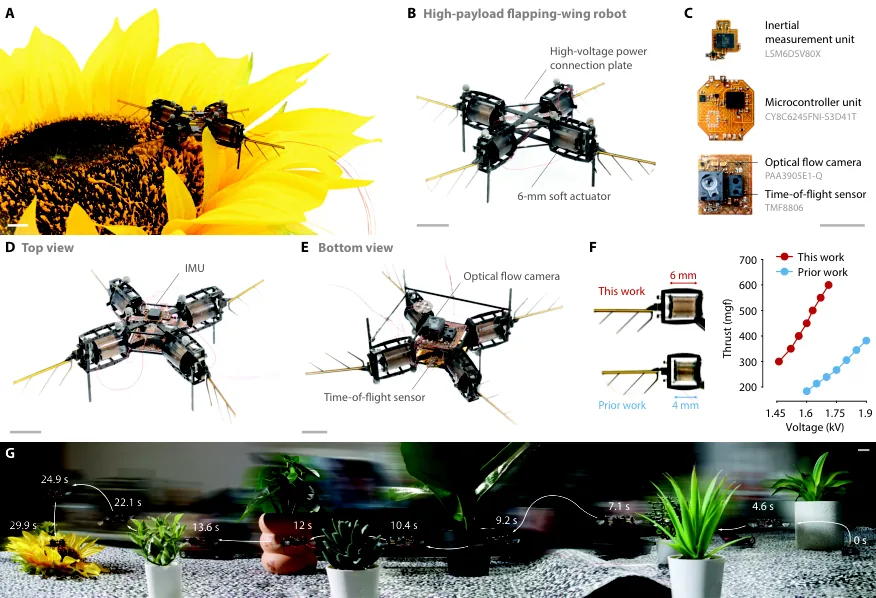
MIT and Cornell researchers describe a flapping-wing microrobot that can follow trajectories and land on a sunflower without a lab motion-capture system.
Robotics
Boston Dynamics announces a second-generation Stretch trailer-unloading robot
In a 3 November 2026 product release, the company describes Stretch Gen 2 as an industrial upgrade based on what it says is data from more than 100,000 operating hours.