An ultra-flexible auditory brainstem implant stays stable for more than 136 days in rats
A Nature Communications paper published 22 November 2026 reports uFINE, a high-density, ultra-flexible penetrating electrode array, which in normal-hearing rats produced frequency-selective cochlear-nucleus stimulation that remained stable for more than 136 days.
Listen
AI-generated voices, script based on this article · 4:27
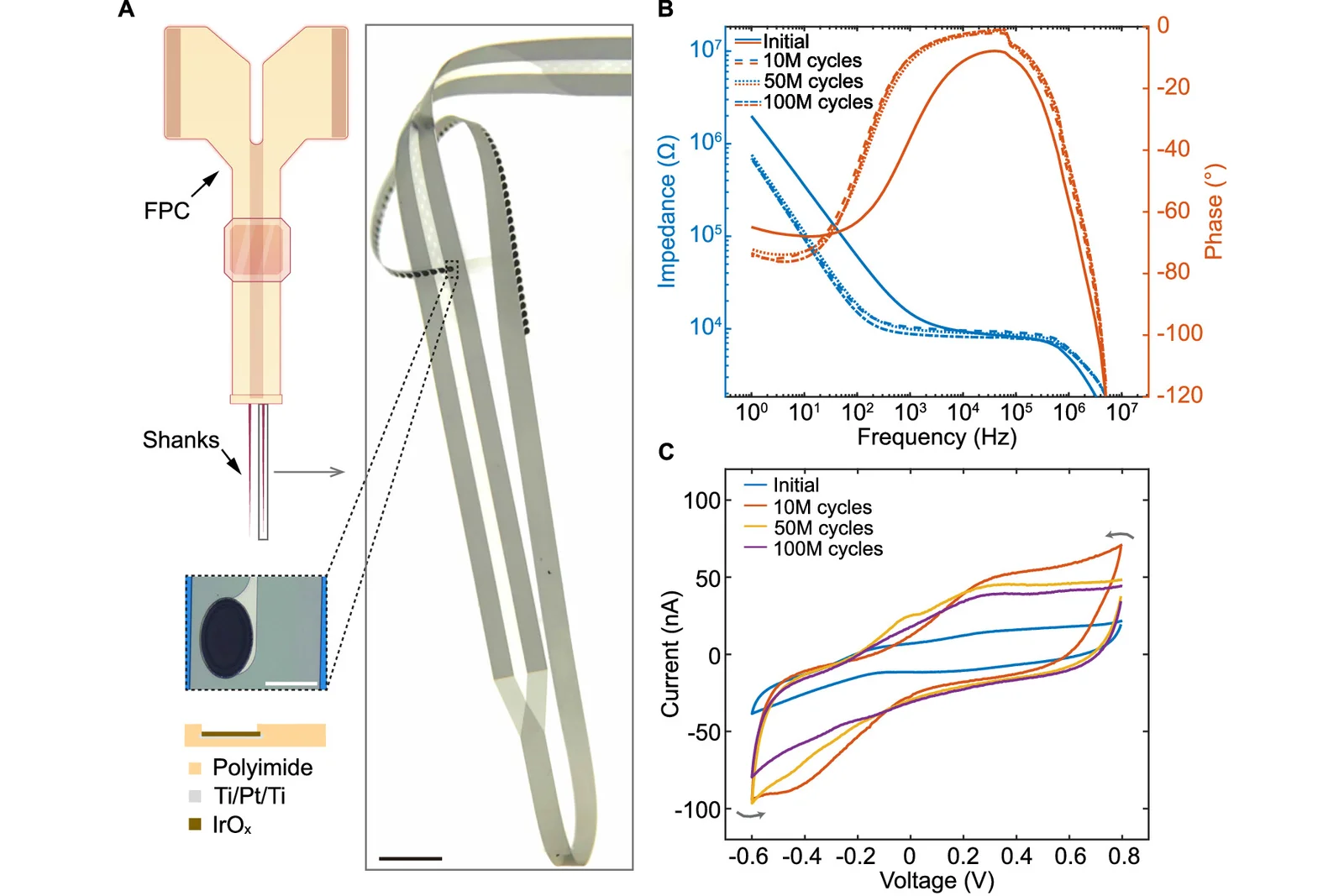
Nature Communications published an open-access paper on 22 November 2026 in which Jinxi Pan, Bodi Liu, and colleagues describe uFINE, a high-density, ultra-flexible penetrating electrode array intended as a penetrating auditory brainstem implant (ABI). Pan and Liu contributed equally. Corresponding authors are Chi Ren, Zhengtuo Zhao, and Hao Wu. The team is based at Shanghai Ninth People's Hospital, Shanghai Jiao Tong University School of Medicine, the Ear Institute, and the Institute of Neuroscience, Center for Excellence in Brain Science and Intelligence Technology, Chinese Academy of Sciences.
The authors write that conventional ABIs that use a surface electrode array have highly variable outcomes, from poor to moderate, because of limited spatial resolution and restricted tonotopic access. In normal-hearing rats, they report that uFINE mapped frequency tuning from 0.5 to 32 kHz in the cochlear nucleus (CN) and the inferior colliculus (IC). Selective CN stimulation evoked IC responses that closely matched acoustic tonotopy, with IC tuning widths comparable to tone-evoked responses, and the authors report that these responses remained stable for more than 136 days, with minimal gliosis observed.
Daily sequential CN–IC microstimulation progressively shifted the location of the CN-evoked IC response peak toward the targeted IC stimulation site, a change the authors say is consistent with use-dependent plasticity.
This is a preclinical study in normal-hearing rats, not a human implant trial and not evidence of speech restoration. The paper is an accelerated article preview: a peer-reviewed, accepted version that the journal shared early and that is subject to further edits before the final version of record. Zhengtuo Zhao and Chengyao Wang are inventors on Chinese patent application CN202511555672.3 relating to the ultraflexible penetrating electrode array; Zhao is a co-founder of, and holds equity in, Shanghai StairMed Technology Co., Ltd.
Why it matters
Auditory brainstem implants are used when a cochlear implant is not an option, but surface arrays have limited access to the frequency map in the cochlear nucleus. A penetrating array that, in rats, holds frequency-specific responses for more than 136 days is a preclinical measurement of how stably that map can be reached and stimulated.
Looking ahead (speculative)
The authors highlight the potential of uFINE to enhance ABI-mediated hearing restoration. That possibility is not demonstrated here, and the study does not test the array in people or measure speech.
This is news, not medical advice.